
More than 80% of Chino Hills sits within a state-designated Very High or High Fire Hazard Severity Zone under CAL FIRE’s updated 2025 maps, which shapes nearly every home insurance decision in this San Bernardino County city of about 77,500 residents, according to the U.S. Census Bureau.
Add a fault system running beneath the hills and a median home value near $875,000, and homeowners here are choosing from a smaller pool of carriers than they were five years ago. Old Harbor Insurance works with Inland Empire families to compare that pool and build coverage around what a specific property faces.
Finding a policy that still fits a Chino Hills address takes more legwork than it used to, since several national carriers have pulled back on new homeowners business across California. An independent agency that checks quotes across dozens of carriers, rather than one captive brand, usually turns up options a single insurer’s website won’t show.
Why Chino Hills Carries Unusual Insurance Risk
Chino Hills’ terrain, not its street grid, drives its insurance profile. The city backs up to Chino Hills State Park and Tonner Canyon, both wildland areas that have burned repeatedly, and it sits close enough to active faults that a moderate earthquake has already struck directly beneath it.
Wildfire Exposure in the Hills and Canyons
The November 2008 Freeway Complex Fire burned roughly 90% of Chino Hills State Park and forced evacuations across Corona, Chino Hills, Yorba Linda, and Anaheim, according to CAL FIRE’s incident record.
A Hills For Everyone research review traced fire activity near the park back nearly a century, and found the same ignition points recurring in the canyons that border neighborhoods today.
That risk hasn’t faded. CAL FIRE’s 2025 map update placed more than 7,300 acres of Chino Hills State Park into Very High severity zones, and the city has since expanded brush clearance and prescribed burn work in Tonner Canyon in response.
Earthquake Risk From the Chino and Whittier Faults
Chino Hills already has a seismic event of its own. On July 29, 2008, a magnitude 5.4 earthquake struck directly beneath the city, the largest to hit greater Los Angeles since the 1994 Northridge quake, according to a preliminary report from the U.S. Geological Survey. No one died, but the shaking reached as far as Las Vegas and San Diego.
That event occurred on the Yorba Linda fault, part of a broader system tied to the Chino and Whittier faults, which USGS-funded research says can produce a magnitude 6.0 to 7.0 earthquake in the region. Standard homeowners policies exclude this kind of shaking damage entirely, which is why earthquake coverage is a separate purchase for anyone budgeting for a Chino Hills home.
What a Standard Chino Hills Home Insurance Policy Covers
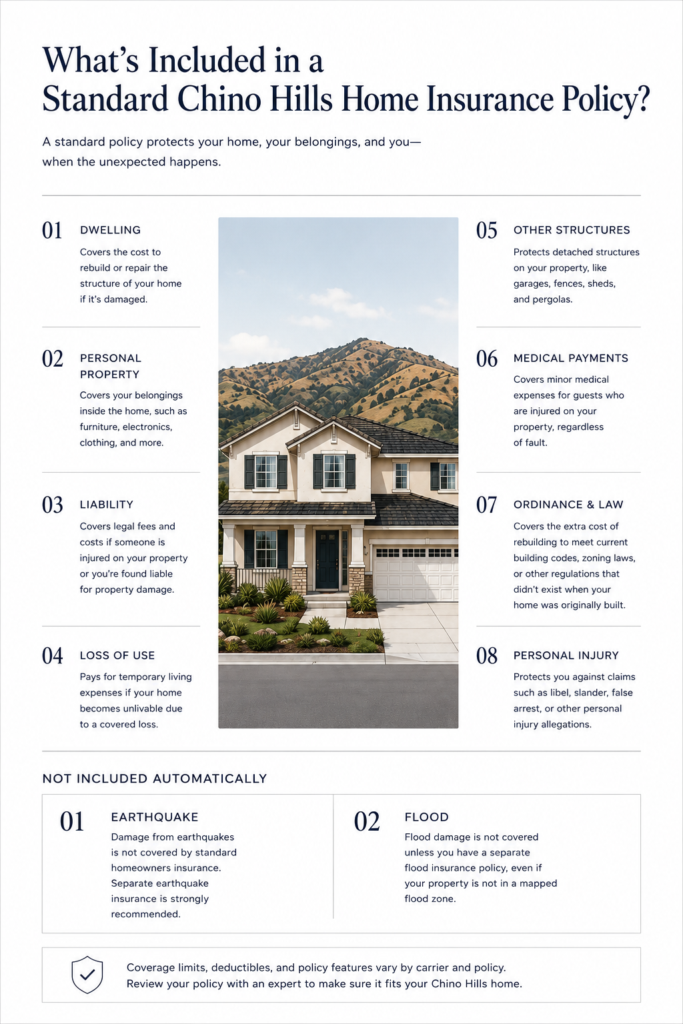
A typical homeowners policy is built from several distinct pieces, and knowing what each one does matters before a claim happens, not after. Old Harbor structures Chino Hills policies around these core components:
- Dwelling – rebuilds the physical structure of the home itself
- Other Structures – covers detached garages, fences, and sheds
- Personal Property – protects belongings inside the home
- Loss of Use – pays for temporary housing if the home becomes unlivable
- Liability – covers legal costs if someone is injured on the property
- Medical Payments – covers minor injury costs regardless of fault
- Ordinance and Law – covers the added cost of rebuilding to current code
- Personal Injury – protects against claims like libel or false arrest
Ordinance and Law coverage matters more in Chino Hills than in a lot of cities, since homes damaged in a major wildfire or earthquake often have to be rebuilt under codes that didn’t exist when they were first built. Without that add-on, homeowners can be left covering the code-compliance gap out of pocket. Old Harbor’s claims resource on property coverage breaks down how these pieces interact once a claim is filed.
Why California Home Insurance Has Gotten Harder to Find
Several large insurers have scaled back or paused new homeowners business across California since 2022, citing wildfire exposure and rebuilding cost inflation. That retreat has pushed hundreds of thousands of homeowners statewide toward the California FAIR Plan, the state’s insurer of last resort, which now covers a record share of California homes as standard-market coverage has tightened.
For a Very High FHSZ city like Chino Hills, that shift means fewer standard-market carriers are writing new business without added underwriting scrutiny, documented defensible space, or higher premiums. An independent agency exists for exactly this kind of market, since a single-carrier agent has no fallback once their own company declines a property.
Earthquake and Flood Coverage Gaps to Know About
Only about 10% to 11% of California homeowners carry earthquake insurance, largely because standard HO-3 policies exclude it outright and deductibles through the California Earthquake Authority typically start at 5% of the dwelling limit. On an $875,000 home, that’s roughly $43,750 out of pocket before coverage responds, a number worth knowing given how active the Chino and Whittier faults are.
Flood risk is a smaller factor for most Chino Hills properties, which sit largely in FEMA Zone X outside mapped floodplains, though homes near Carbon Canyon Creek in the Sleepy Hollow area should confirm their own flood zone rather than assume no coverage is needed.
How Old Harbor Insurance Helps Chino Hills Homeowners
Old Harbor represents 81 A-rated carriers rather than a single company, which means a Chino Hills homeowner gets one point of contact who can compare options across carriers instead of relying on one insurer’s underwriting appetite. That structure matters most in Very High FHSZ zones, where availability shifts from one carrier to the next.
The agency also builds each policy around the specific property: its fire hazard zone, proximity to open space, age of construction, and whether earthquake or flood coverage should sit alongside the base homeowners policy. That review happens before a quote is generated, not after a gap surfaces during a claim.
Get Chino Hills Coverage That Matches Your Risk
A policy built for a flatland suburb doesn’t hold up the same way in a Very High Fire Hazard Severity Zone bordering open wildland. Old Harbor’s team reviews Chino Hills properties individually, checking fire zone designation, rebuild cost, and earthquake exposure before recommending a carrier. Reach out through Contact Us to talk through your specific address, or start with a Get a Quote request to see how current options compare.
Frequently Asked Questions
What does umbrella insurance add on top of a Chino Hills homeowners policy?
Umbrella insurance adds a layer of liability protection above the limits in a standard homeowners or auto policy, typically running $150 to $200 a year for the first $1 million in coverage. California’s litigation environment makes that gap worth closing, since a single liability judgment can exceed a standard policy’s limits.
Does a homeowners policy cover smoke damage from a nearby wildfire, even if the fire never reaches the house?
Yes, smoke and soot damage from a wildfire is generally covered under the fire peril in a standard homeowners policy, even when flames never touch the structure. Carriers may still ask for documentation tying the damage to a specific fire event.
How much defensible space does California law require around a Chino Hills home?
State law requires 100 feet of defensible space around structures in fire hazard zones, split into an ember-resistant zone closest to the house and wider vegetation-management zones beyond it, under California Public Resources Code 4291. San Bernardino County and the city can add requirements on top of that state minimum.
Does an HOA’s insurance policy cover individual homes in Chino Hills communities like Vellano or Butterfield Ranch?
No, an HOA master policy in a single-family community typically covers common areas and shared amenities, not the individual dwelling. Homeowners in these communities still need their own policy to cover the structure, personal property, and liability.
Does bundling home and auto insurance lower costs for Chino Hills homeowners?
Bundling often lowers the combined premium, since many carriers discount for holding both policies with the same company. The savings vary enough by carrier that it’s worth comparing a bundled quote against separate policies before assuming it’s cheaper.
What should Chino Hills homeowners document before a wildfire evacuation?
A home inventory with photos or video of belongings, kept somewhere other than the house along with copies of policy documents, makes a personal property claim move faster after an evacuation. Serial numbers and receipts for higher-value items help settle disputes over what something was worth.
Does living farther from a fire station affect home insurance eligibility in Chino Hills?
Yes, distance from a fire station and the type of water supply available factor into a property’s fire protection class, which carriers weigh alongside the state’s fire hazard zone rating. Homes deep in the hills or canyons tend to see this factor weighed more heavily than homes closer to a station.