
Bamboo Insurance has become a visible name for California homeowners dealing with non-renewals, wildfire underwriting, and shrinking carrier appetite. The important distinction is structural: Bamboo Ide8 Insurance Services is a managing general agency, not one insurance company. Old Harbor Insurance can compare a Bamboo option with other admitted, specialty, surplus lines, and California FAIR Plan arrangements available for a specific property. That comparison matters because the issuing carrier and endorsements, not the marketing name alone, determine the contract.
Bamboo can be a private-market alternative to the FAIR Plan when one of its partner programs accepts the home, but availability is not automatic. Old Harbor can check whether a Bamboo placement fits by comparing the issuing carrier, policy form, wildfire terms, rebuilding limit, deductible, and inspections with the other routes open at the address. A private quote should be measured against the combined FAIR Plan and DIC package, not the fire policy by itself. That comparison should also account for lender requirements and any inspection conditions that must be completed after binding.
What Bamboo Insurance Is in California
Bamboo’s own licensing disclosure identifies Bamboo Ide8 Insurance Services, LLC as a managing general agency licensed to sell property-casualty products under California license 0M31082. The Bamboo corporate site offers consumer quoting and agent distribution, while the insurer named on the declarations page supplies the contractual coverage.
The Issuing Carrier Matters More Than the Brand on the Website
An MGA can design programs, manage underwriting, distribute policies, and coordinate service for carrier partners. It does not mean every Bamboo-branded quote uses the same insurer, form, appetite, or claims arrangement. Homeowners should record the legal insurer, NAIC number, financial-strength information, claims contact, and all endorsements before binding.
That distinction also affects how regulatory protections apply. An admitted carrier uses California-filed rates and forms and may participate in the state guaranty system, while a surplus lines carrier operates under a different placement framework.
Bamboo Expanded Its Admitted California Capacity in 2026
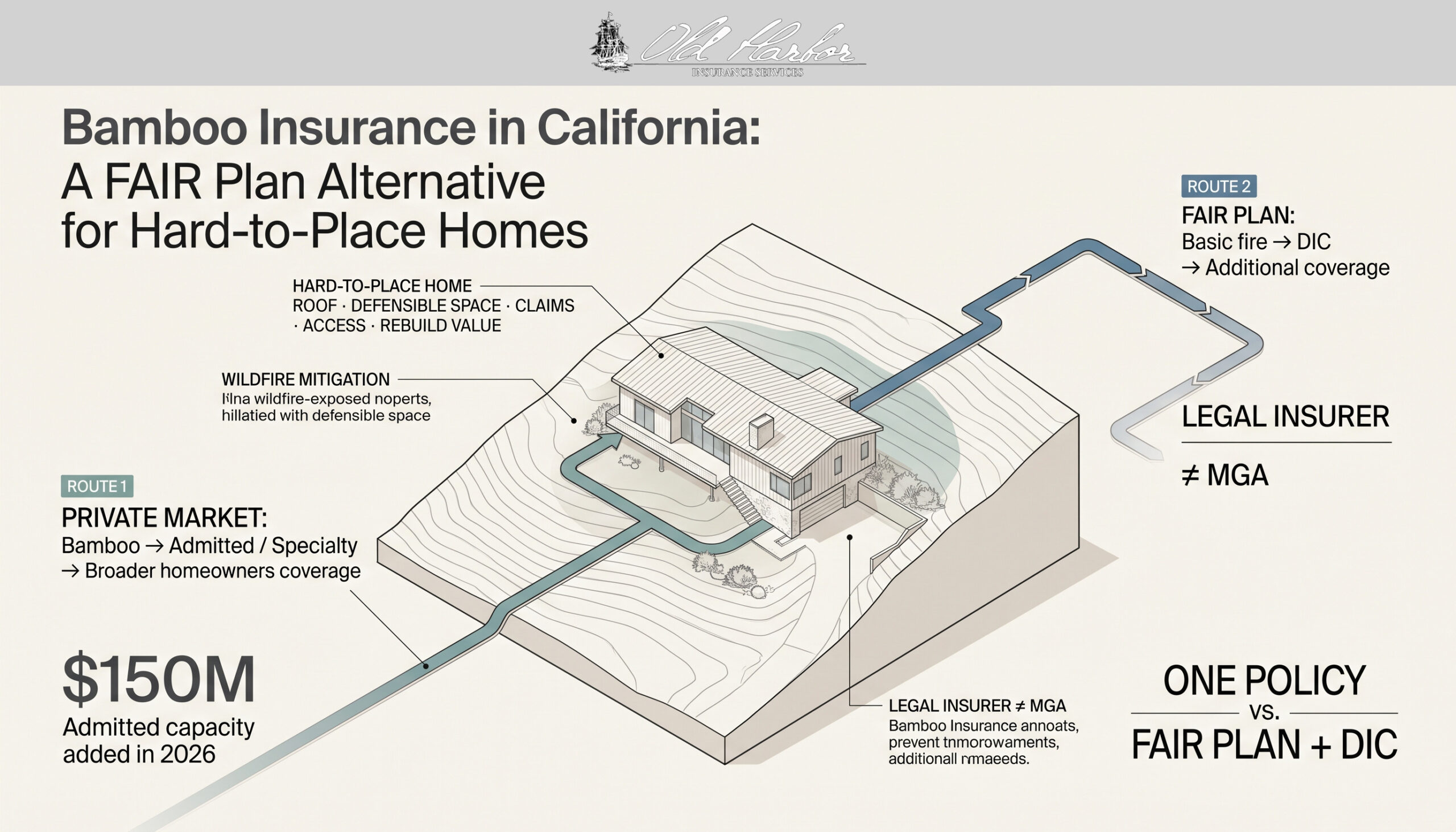
In July 2026, Bamboo announced a Transverse partnership adding approximately $150 million in admitted California homeowners capacity, with new-business and renewal options distributed through Bamboo’s independent-agent network. The company’s capacity announcement described lower-premium options and greater flexibility within its portfolio.
Capacity is not the same as guaranteed eligibility. The address, wildfire model, roof, construction, prior claims, insurance score where permitted, reconstruction value, mitigation, and concentration in the surrounding area can still determine whether a program quotes.
How Bamboo Differs From the California FAIR Plan
The California FAIR Plan is the state’s insurer of last resort for basic property insurance when coverage is not reasonably available elsewhere. Bamboo is a private insurance distribution platform whose programs remain subject to carrier underwriting. The two routes solve different problems.
A Private Homeowners Policy May Package More Coverage
A private homeowners form may combine dwelling, other structures, personal property, loss of use, liability, and medical-payments coverage, subject to its terms. The Bamboo California homeowners page acknowledges that availability, limits, exclusions, endorsements, and deductibles vary by carrier and property.
The FAIR Plan’s base role is narrower. The California Department of Insurance describes it as basic fire coverage and notes expanded residential limits and mitigation discounts on its FAIR Plan information page. Many households pair FAIR Plan fire coverage with a DIC policy to address additional perils and liability.
One Policy Is Simpler Only If the Coverage Is Comparable
Replacing a FAIR Plan and DIC combination with one private policy can reduce billing and claims coordination. Simplicity has value, but the comparison must still test covered causes of loss, water limits, theft, wildfire deductible, ordinance and law, debris removal, trees and landscaping, loss of use, and replacement-cost conditions.
A private policy is not automatically broader in every respect. Endorsements can remove or cap coverage, and wildfire terms may be property-specific.
Which Hard-to-Place Homes May Fit Bamboo
Bamboo markets California homeowners options for consumers responding to non-renewals or price changes. Homes that fit a partner carrier’s wildfire, construction, roof, occupancy, and value rules may receive an offer even when a large national carrier has declined.
Wildfire Mitigation Can Change the Underwriting File
Insurers may ask for roof age and material, enclosed eaves, ember-resistant vents, defensible space, tree clearance, alarms, hydrant distance, road access, and photographs. Bamboo’s discussion of California’s fire-resistant roofing and home-safety grants points to Zone Zero work, fire-safe roofs, and defensible-space improvements as measures that can improve resilience and may affect insurability.
Mitigation should be documented, not merely described. Dated photographs, paid invoices, inspection results, permits, and material specifications let the broker correct stale property data and present the risk accurately.
Some Properties Will Still Need Another Route
A home may remain outside Bamboo’s appetite because of extreme wildfire concentration, roof condition, vacancy, active renovation, unrepaired damage, short-term rental use, prior losses, or a rebuilding value beyond program limits. A declination from Bamboo does not mean the only remaining option is the FAIR Plan.
Other possibilities can include another admitted carrier, a high-value program, surplus lines coverage, a vacant or builder’s-risk form, or a FAIR Plan and DIC pairing. Each has different protections and costs.
How to Compare a Bamboo Quote With a FAIR Plan Package
Start with the legal insurer and full policy form, then compare the entire annual cost rather than one headline premium. A FAIR Plan quote should be combined with the DIC premium and any separate liability or ancillary coverage needed to approximate the private policy.
Coverage Comparison Checklist
- Dwelling limit and any extended replacement-cost percentage
- Other structures and detached-building limits
- Personal property valuation and special sublimits
- Loss of use or fair rental value
- Personal liability and medical payments
- Water, theft, vandalism, wind, and smoke provisions
- Wildfire and all-other-peril deductibles
- Ordinance and law, debris removal, and landscaping
- Inspection, alarm, and mitigation conditions
- Minimum earned premium, cancellation, and payment terms
The FAIR Plan combination may still be appropriate where no private offer satisfies the lender or the owner. A Bamboo quote may be preferable where its policy provides a workable blend of breadth, limits, and premium.
What to Verify Before Replacing Existing Coverage
Do not cancel the FAIR Plan or DIC policy until the new policy is bound, paid, and accepted by the lender. The effective dates should overlap or meet cleanly, and the mortgagee clause, dwelling amount, deductible, and proof-of-insurance delivery should be confirmed.
Store the application, inspection responses, photographs, declarations, and endorsements. If a loss occurs, those records help establish what was disclosed and support the property-claim process.
How Old Harbor Insurance Helps
Old Harbor Insurance is an independent broker, not Bamboo and not the California FAIR Plan. The agency can compare Bamboo’s current program with other carriers and structures available to the home, then explain which company issues the policy and where material exclusions differ.
The comparison can also identify whether mitigation documentation, a corrected reconstruction estimate, roof records, or a different occupancy classification could change the result. Carrier appetite shifts, so a home that had one option last year may have several at the next renewal.
Compare Bamboo With the Full Market
Bamboo can be a useful California option, but the brand name alone does not establish the best fit. Contact Old Harbor Insurance to review a Bamboo quote or non-renewal, or request a quote to compare private-market and FAIR Plan alternatives for the property.
Frequently Asked Questions
Is Bamboo Insurance an admitted insurer in California?
Bamboo is an MGA, not a single admitted insurer. A Bamboo-distributed policy may use an admitted carrier or another eligible structure, so the declarations page controls the answer for a particular quote.
Does Bamboo write every California ZIP code?
Bamboo does not guarantee eligibility in every ZIP code or for every property. Availability depends on the active partner program, modeled risk, property features, and underwriting capacity at the time of application.
Can Bamboo replace both a FAIR Plan and DIC policy?
A Bamboo-distributed homeowners policy can replace both policies when it provides the required fire and broader homeowners coverage and the lender accepts it. The owner should compare forms and effective dates before cancelling either existing policy.
Does Bamboo offer earthquake insurance with homeowners coverage?
Earthquake damage is generally excluded from homeowners coverage. A separate earthquake policy may be available through another insurer or program and should be evaluated independently.
Who handles a claim on a Bamboo policy?
The declarations and claims instructions identify the insurer and the party responsible for receiving and adjusting the claim. Homeowners should save that information rather than assuming every Bamboo-distributed policy uses the same claims operation.
Will Bamboo accept a home with an older roof?
Roof eligibility depends on material, age, condition, remaining life, and the current partner program. Inspection photographs or proof of replacement may be required before or after binding.
Can a homeowner move from Bamboo back to the FAIR Plan later?
A homeowner can apply for FAIR Plan coverage later if private insurance is no longer reasonably available and the property meets FAIR Plan requirements. The broker should avoid a lapse while the replacement application is reviewed.