

California requires every active C-20 warm-air heating, ventilating, and air-conditioning contractor to carry workers’ compensation insurance, even a sole proprietor with no employees at all, according to the C-20 licensing requirements of the Contractors State License Board.
We build HVAC insurance in California for that standing requirement, since it applies to a one-truck operator the same way it applies to a full installation crew.
A furnace connection, a refrigerant line, or a gas fitting keeps operating long after the invoice is paid, and an installation error can surface as a fire or carbon-monoxide claim months or years later.
HVAC insurance in California therefore combines liability, workers’ compensation, vehicle, and equipment coverage around the contractor’s actual work. Reviewing those exposures before renewal is the simplest way to catch a gap before a customer or general contractor asks for proof. If the business has added staff, vehicles, or new installation work since its last review, Old Harbor can help identify coverage gaps before the next renewal or certificate request.
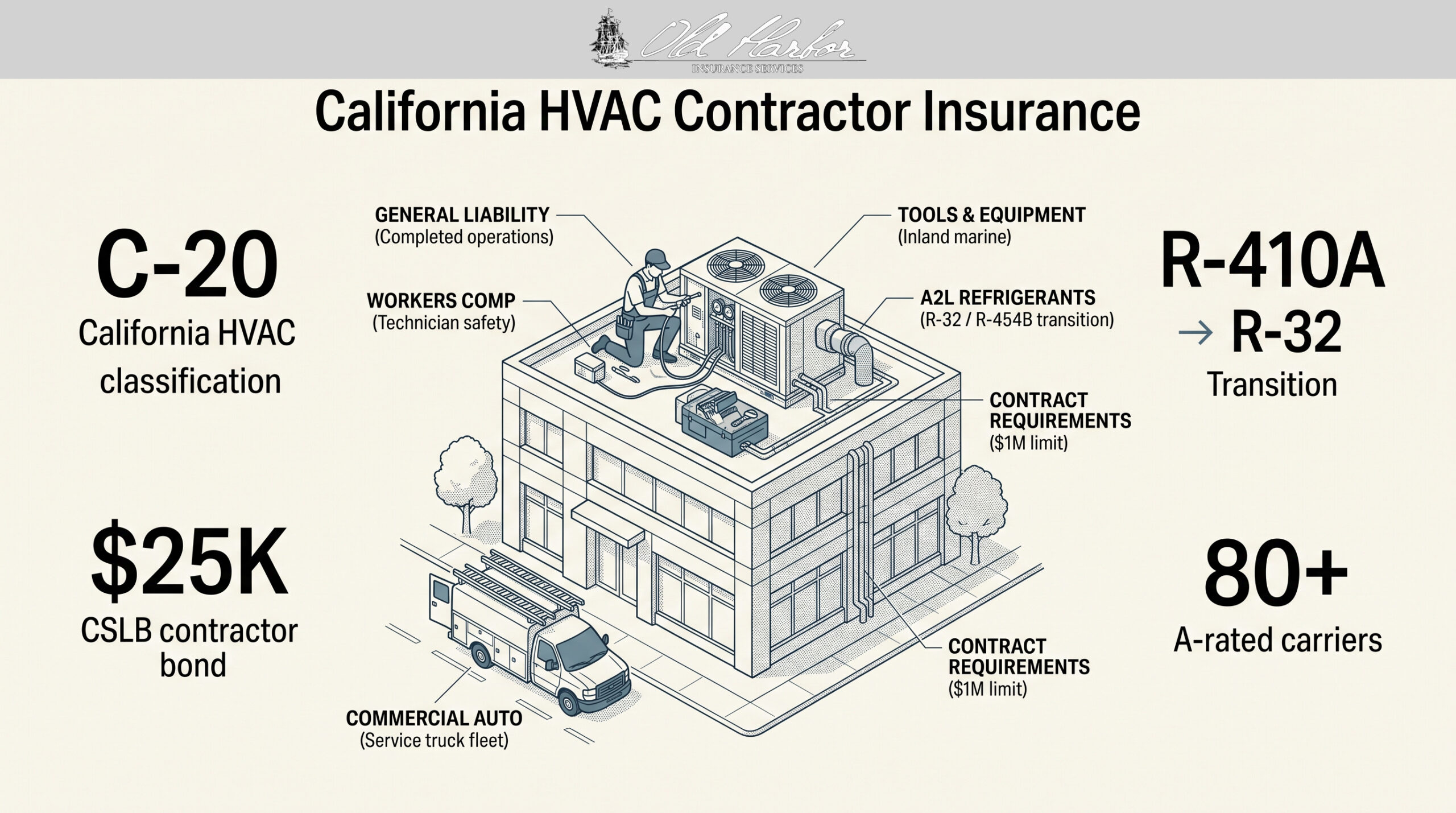
What HVAC Insurance Covers in California
Coverage at a Glance
- General liability and completed operations: Injury or property damage from work performed, including after the job is finished
- Workers’ compensation: Required for every active C-20 licensee, with or without employees
- Commercial auto: Service trucks and vehicles moving between job sites
- Tools and equipment (inland marine): Compressors, gauges, refrigerant recovery machines, and tools left on a truck or job site
- Contractor’s bond: The $25,000 CSLB bond, which protects consumers and unpaid wages, not the contractor’s own liability
- Commercial umbrella: Extra liability limit above general liability and auto for larger commercial installs
General Liability and Completed Operations Coverage
General liability covers the obvious accidents (a technician drops a unit on a customer’s floor, a ladder damages a client’s roof) but its completed operations piece is what matters most for HVAC work specifically. That’s the part of the policy that responds to a claim filed after the job is done and the crew has left the property, which is exactly when a bad refrigerant connection or an improperly vented furnace tends to show up.
General liability is commonly written on an occurrence basis, but the policy that responds depends on when the covered bodily injury or property damage is deemed to have occurred, not simply when the installation was completed. Contractors should retain old policies and certificates because a completed-operations claim may surface long after the job.
Workers’ Compensation Applies Even With No Employees
Most California trade licenses only require workers’ compensation once a contractor hires staff. The C-20 classification doesn’t work that way: active licensees have to carry coverage or a valid Certification of Self-Insurance regardless of headcount. A solo technician running service calls out of a personal truck is still expected to carry it, which surprises contractors coming from trades where the rule only kicks in with the first hire.
Tools, Equipment, and Commercial Auto Coverage
A commercial auto policy covers the truck and the liability of driving it, not the compressors, gauges, and refrigerant recovery equipment riding in the back. That equipment usually needs its own inland marine or equipment floater policy, since a stolen or damaged tool inventory is a property loss auto coverage was never built to touch.
Why California HVAC Contractors Face Distinct Insurance Risks
The A2L Refrigerant Transition Is Changing the Liability Picture
The EPA’s phase-down of high-GWP refrigerants means R-410A, with a global warming potential of 2,088, is giving way to alternatives like R-32 and R-454B, rated at 675 and 466 respectively, with manufacturing restrictions on the older refrigerant beginning January 1, 2026.
The catch is that the newer refrigerants are classified as A2L, or mildly flammable, which brings enhanced leak detection, updated ventilation protocols, and manufacturer-specific certification requirements into play for the first time on residential and light commercial systems. A technician handling A2L refrigerant without that certification, or a system installed without the required leak detection, creates a liability question; a policy written for R-410A-only work was never designed to price.
Rooftop and Exterior Equipment Shares California’s Wildfire Exposure
Condenser units and rooftop package units installed at a customer’s property sit exposed to the same embers, ash, and smoke damage that threaten the structure itself. A policy written only around the contractor’s own shop, trucks, and tools doesn’t extend to equipment already installed at a job site if it’s damaged before a project is fully signed off, which matters most for larger commercial installs that stretch across a wildfire season.
Contract Requirements and Additional Insured Status
General contractors, property managers, and commercial building owners often require an HVAC contractor to provide a certificate of insurance before work begins. The certificate confirms that coverage exists, but it does not change the policy by itself. If the contract requires the client to be protected under the contractor’s liability policy, the contractor usually needs a separate additional-insured endorsement.
Written contracts also affect how a claim is allocated between the HVAC contractor, a subcontractor, and the property owner. Reviewing indemnity language, waiver-of-subrogation requirements, and completed-operations wording before signing helps the policy match the promises made in the contract.
How Much Does HVAC Insurance Cost in California?
Crew size, and whether the business leans toward service calls or new construction, move the price the most. New construction and commercial rooftop work involve gas line connections and larger refrigerant charges than a routine service call, which carries more liability exposure per job. Claims history, fleet size, and how much tool and equipment inventory rides in company trucks all factor in from there.
How Old Harbor Insurance Helps
Not every carrier prices HVAC work the same way, particularly once gas line work, commercial rooftop installs, or a fleet of service vehicles enters the picture. Old Harbor Insurance works with more than 80 A-rated carriers, comparing coverage instead of settling for whatever one company is willing to write. How a commercial property claim moves from filing to payout is worth understanding before a completed-operations claim tests it for the first time.
Your HVAC policy should reflect the work you do today, not the business you were when coverage began. Contact Old Harbor Insurance to review your protection before the next renewal, commercial bid, or job-site requirement exposes a gap. You can also request a quote to compare general liability, workers’ compensation, commercial auto, and equipment coverage across multiple carriers.
Frequently Asked Questions
Does the $25,000 CSLB contractor’s bond take the place of general liability insurance?
No. The CSLB bond exists to protect consumers from defective work and employees from unpaid wages, and it isn’t described as a guarantee that a contractor will finish a job or as coverage for third-party injury or property damage. General liability insurance is a separate policy that responds to those claims, and a contractor carrying only the bond has no coverage for a customer’s injury or a damaged property.
Does a general liability policy cover a fire caused by a furnace installed years earlier?
It can, but the policy that responds is usually the one that was active at the time of the original installation, not the contractor’s current policy. Since general liability is typically written on an occurrence basis, a lapse in coverage between the original job and the claim doesn’t remove the exposure, it just makes the older policy harder to track down when the claim eventually surfaces.
Is workers’ compensation really required for a solo HVAC technician with no employees?
Yes. Active C-20 licensees in California are required to carry workers’ compensation insurance or a valid Certification of Self-Insurance regardless of whether they have any employees, which differs from many other contractor classifications where the requirement only applies once staff are hired.
Does a standard HVAC policy automatically cover work with the newer A2L refrigerants?
Most general liability policies don’t carry an outright exclusion for A2L refrigerant work, but insurers are actively updating underwriting questions around technician certification and leak detection equipment as the transition rolls out. Confirming how a specific carrier treats A2L work, rather than assuming it’s business as usual, avoids a coverage dispute after a claim tied to the newer refrigerants.
Does commercial auto insurance cover tools stolen from a service truck overnight?
No. Commercial auto covers the vehicle and the liability of driving it, not the tools and equipment inside it. A stolen compressor, gauge set, or refrigerant recovery machine is a property loss that needs its own inland marine or equipment floater coverage.
Does a subcontracted duct cleaning or sheet metal crew need to be added to an HVAC contractor’s policy?
A subcontractor should generally carry its own liability coverage, and the hiring contractor typically asks to be named as an additional insured on that policy rather than adding the subcontractor to its own. Skipping that step means the hiring contractor’s own policy could end up responding to a subcontractor’s mistake.
What insurance limits do commercial clients usually require from an HVAC contractor?
Commercial clients commonly require at least $1 million per occurrence in general liability coverage and may request higher aggregate or umbrella limits for larger projects. The contract, not a statewide HVAC rule, sets the final requirement, so contractors should review insurance clauses before bidding and obtain any required additional-insured endorsements before work begins.