

If you’ve been shopping for homeowners insurance in California and received a notice about the California FAIR Plan, you’re probably wondering whether this last-resort option will drain your budget. The short answer: California FAIR Plan policies typically cost 2-3 times more than traditional homeowners insurance, with significantly reduced coverage that often leaves policyholders underinsured and exposed to substantial financial risk.
The California FAIR Plan was never designed to be an affordable long-term solution. Created in 1968 as the state’s insurer of last resort, it serves homeowners who cannot obtain coverage through the standard insurance market—typically those in high-risk wildfire zones.
While it provides basic fire coverage when no other options exist, the program’s premiums reflect this elevated risk profile, and the coverage gaps require expensive supplemental policies.
For California homeowners facing FAIR Plan placement, understanding the true cost extends beyond just premium dollars. This analysis examines real pricing data, coverage limitations, and—most importantly—viable alternatives that many homeowners overlook. Independent insurance agencies like Old Harbor Insurance maintain relationships with multiple carriers specifically equipped to handle properties that might otherwise default to the FAIR Plan, often securing comprehensive coverage at competitive rates.
Understanding California FAIR Plan Pricing Structure
The California FAIR Plan operates on a risk-based pricing model that categorizes properties by construction type, location, and coverage limits. Unlike traditional insurers who spread risk across diverse portfolios, the FAIR Plan concentrates high-risk properties, which fundamentally drives up costs.
Base Premium Calculations
FAIR Plan premiums start with a base rate determined by your home’s replacement cost coverage limit. For a typical $400,000 dwelling in a high-fire-severity zone, annual premiums range from $3,200 to $4,800—compared to $1,200 to $1,800 for the same property with traditional coverage before market disruptions. The pricing reflects several key factors:
- Fire-only coverage focus: The policy primarily covers fire damage, the most expensive peril to insure in wildfire-prone areas
- Limited risk pooling: Without the diversification traditional insurers achieve, each policy bears more direct risk cost
- No competition incentive: As a state-mandated program rather than a competitive marketplace offering, pricing lacks market pressure for affordability
Additional Cost Factors
The published FAIR Plan premium represents only part of your total insurance expense. California regulations require FAIR Plan policyholders to purchase a separate Difference in Conditions (DIC) policy to cover perils excluded from the base plan—theft, vandalism, water damage, liability protection.
These supplemental policies add another $800 to $2,000 annually depending on coverage levels and property characteristics.
When you factor in both the FAIR Plan base policy and required DIC coverage, total annual costs for comprehensive protection frequently reach $5,000 to $6,800 for a standard single-family home—representing a 200-300% increase over traditional all-peril homeowners policies.
Coverage Limitations That Increase True Costs
Beyond premium expenses, the California FAIR Plan’s coverage restrictions create financial exposure that effectively increases your real cost of insurance through gaps in protection.
Dwelling Coverage Caps
The FAIR Plan limits dwelling coverage to $3 million per property—adequate for most homes, but insufficient for high-value properties common in California’s coastal and urban markets. Homeowners with properties exceeding this threshold must secure excess coverage elsewhere, adding complexity and expense.
Personal Property and Additional Structures
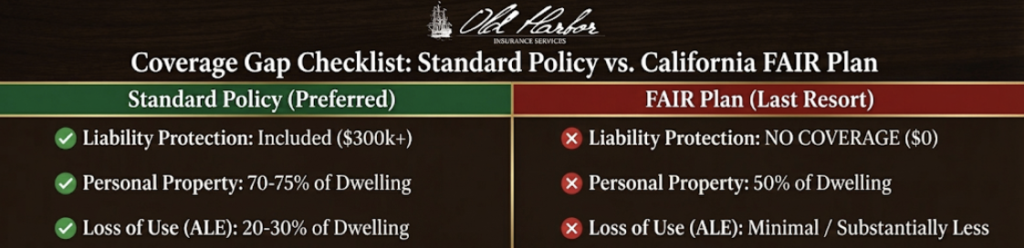
Standard FAIR Plan policies provide minimal coverage for personal belongings (typically 50% of dwelling coverage) and other structures like detached garages or guesthouses (10% of dwelling coverage). Traditional homeowners policies generally offer 70-75% for personal property and 10-20% for other structures, with higher limits readily available. Upgrading FAIR Plan coverage to comparable levels requires additional premium payments.
No Liability Protection
Perhaps the most significant gap: FAIR Plan policies include zero liability coverage. If someone is injured on your property, you have no protection against resulting lawsuits through your FAIR Plan policy. A separate liability policy costs $300 to $800 annually depending on limits—an expense entirely included in traditional homeowners insurance at no additional charge.
Limited Additional Living Expenses
If fire damages your home and you need temporary housing during repairs, the FAIR Plan provides minimal additional living expense coverage. Traditional policies typically offer 20-30% of dwelling coverage for loss-of-use expenses; FAIR Plan policies offer substantially less, potentially leaving you to cover hotel or rental costs out-of-pocket during extended reconstruction periods.
Real Cost Comparison: FAIR Plan vs. Traditional Coverage
To understand the true expense differential, consider this side-by-side analysis for a $500,000 home in Southern California’s wildfire interface zone:
Traditional Homeowners Insurance (Before Market Disruption)
- Annual premium: $1,500 – $2,200
- Dwelling coverage: $500,000
- Personal property: 75% ($375,000)
- Liability protection: $300,000 included
- Additional living expenses: $150,000 (30%)
- All-peril coverage: Yes
- Total annual cost: $1,500 – $2,200
California FAIR Plan Solution
- FAIR Plan base premium: $4,000 – $5,200
- Dwelling coverage: $500,000 (fire only)
- DIC policy for other perils: $1,200 – $1,800
- Separate liability policy: $500 – $800
- Total annual cost: $5,700 – $7,800
- Cost increase: 280-355% over traditional coverage
This comparison reveals why homeowners actively seek alternatives to the FAIR Plan. The program fulfills its mandate as a last-resort option, but creates a substantial financial burden for families already stressed by California’s housing costs. McKinsey findings show similar cost comparisons.
Important Context & Limitations
- The FAIR Plan numbers vary dramatically by ZIP code and risk; some premiums may be far higher (e.g., >$10K for very risky homes) or lower.
- Traditional homeowners insurance in very high wildfire zones may not be available at any price from private insurers, which is why many people end up in the FAIR Plan.
- Published averages are usually for a range of homes and coverages, and exact figures depend on many underwriting factors.
Why Independent Agencies Offer Better Options
Many homeowners assume they’re destined for the FAIR Plan after receiving non-renewal notices from their previous insurers. However, independent insurance agencies maintain access to specialized carriers and programs unavailable through direct-to-consumer channels or captive agents.
Specialized Carrier Networks
Independent agencies work with dozens of insurance companies, including specialized carriers focusing on properties other insurers decline. These carriers use advanced risk assessment models that evaluate individual property characteristics—defensible space implementation, fire-resistant materials, roof condition, proximity to fire stations—rather than simply declining all homes in designated high-risk zones.
Old Harbor Insurance, for example, partners with carriers specifically underwriting properties in California’s wildfire interface. Their agents understand which carriers evaluate which risk factors most favorably, allowing them to match properties with insurers most likely to offer competitive coverage.
Competitive Shopping Advantage
Unlike captive agents representing a single insurance company, independent agencies can simultaneously quote your property with multiple carriers. This competitive approach often reveals coverage options and pricing homeowners didn’t know existed. While one carrier might decline coverage or offer only FAIR Plan alternatives, another carrier in the same agency’s network might provide full coverage at rates 30-40% below FAIR Plan costs.
Risk Mitigation Consultation
Forward-thinking independent agencies go beyond simple policy placement. They analyze properties to identify cost-effective mitigation measures that improve insurability—replacing shake shingles with fire-resistant roofing, creating defensible space, installing ember-resistant vents. These improvements can transform an “uninsurable” property into one multiple carriers will cover, often at standard or preferred rates.
Old Harbor Insurance’s consultation approach has helped numerous Southern California homeowners avoid FAIR Plan placement entirely by implementing strategic property improvements before shopping the market. Their team provides specific guidance on which modifications offer the best insurance cost-benefit ratio.
Alternative Coverage Solutions Beyond the FAIR Plan
Even for properties in high-risk areas, several alternatives exist between traditional coverage and FAIR Plan placement:
Admitted Specialty Carriers
Several admitted carriers in California specifically underwrite higher-risk properties that standard carriers decline. These companies use enhanced underwriting models accepting homes with specific risk characteristics:
- Properties with recent wildfire mitigation work (defensible space, fire-resistant materials)
- Homes with good fire protection (proximity to hydrants, quality fire department response)
- Well-maintained properties in otherwise high-risk zones
While premiums from specialty carriers exceed standard market rates—typically 40-70% above pre-crisis pricing—they remain substantially below FAIR Plan costs and provide comprehensive all-peril coverage without supplemental policy requirements.
Surplus Lines Market
California’s surplus lines (non-admitted) insurance market offers another alternative. Surplus lines carriers aren’t bound by traditional rate regulations and can underwrite properties standard carriers won’t touch. These policies typically cost 50-80% more than traditional insurance but 20-30% less than combining FAIR Plan with DIC coverage, while offering more comprehensive protection.
Accessing surplus lines requires working with licensed surplus lines brokers—a specialization many independent agencies maintain. Old Harbor Insurance’s licensed professionals include surplus lines specialists who can access this market segment for qualifying properties.
Hybrid Coverage Structures
Some situations call for creative coverage structures combining multiple policy types. For example:
- FAIR Plan for basic fire coverage ($3,000 annual)
- High-value supplemental policy for extended dwelling limits and superior contents coverage ($1,800 annual)
- Standalone personal liability umbrella policy ($400 annual)
- Total cost: $5,200 vs. $6,800 for full FAIR Plan + DIC approach
While more complex, these customized solutions can reduce costs while maintaining comprehensive protection. Independent agencies have the expertise and carrier relationships to structure and service multi-policy programs effectively.
Property Characteristics Affecting FAIR Plan Necessity
Whether you’ll actually need the California FAIR Plan depends significantly on your specific property characteristics and location. Understanding these factors helps you assess alternatives:
High-Risk Indicators
- Location in Very High Fire Hazard Severity Zone (VHFHSZ)
- Wooden shake or untreated wood shingle roof
- Minimal defensible space (vegetation within 30 feet of structures)
- Limited fire department access (narrow roads, long response times)
- Older home construction lacking modern fire-resistant features
Mitigating Factors
- Class A fire-resistant roofing materials
- 100+ feet of defensible space maintained annually
- Fire-resistant siding and venting systems
- Modern construction (post-2008 building codes)
- Proximity to fire hydrants and quality fire protection
- Located within established residential neighborhoods rather than isolated rural settings
Properties with multiple high-risk indicators and few mitigating factors face higher likelihood of FAIR Plan placement. However, even high-risk properties can often secure traditional or specialty market coverage by addressing the most significant risk factors.
How to Avoid FAIR Plan Placement: Strategic Steps
For California homeowners concerned about forced FAIR Plan enrollment, taking proactive steps significantly improves your chances of securing traditional coverage:
- Property Risk Assessment (3-6 Months Before Renewal)
Conduct a comprehensive property risk evaluation well before your policy renewal date. Identify specific characteristics that might concern insurers—roof condition, defensible space deficiencies, unmaintained vegetation, deteriorating exterior materials. Address these issues systematically, starting with the most impactful improvements.
- Documentation Preparation
Create a detailed property file documenting all fire mitigation measures:
- Photos of defensible space from multiple angles
- Receipts and certifications for fire-resistant roofing installation
- Documentation of vegetation management and property maintenance
- Fire department inspection reports (if available)
- Recent property upgrades improving fire resistance
This documentation helps insurance underwriters make informed decisions rather than declining based solely on location.
- Early Market Shopping
Don’t wait until you receive a non-renewal notice to explore options. Begin shopping 90-120 days before renewal to allow adequate time for multiple carrier quotes and property improvements if needed.
- Independent Agency Consultation
Contact an independent insurance agency specializing in challenging placements. These agencies understand which carriers will consider your specific property characteristics and can structure quotes strategically to highlight your property’s strengths.
Old Harbor Insurance’s approach includes a comprehensive property review before submitting to carriers, ensuring applications emphasize mitigating factors and present the property in the most favorable underwriting light possible. This preparation significantly improves approval odds and pricing.
- Consider Policy Structure Flexibility
Sometimes accepting higher deductibles or specific coverage modifications makes properties more attractive to standard carriers. An independent agent can advise whether a $5,000 deductible or specific endorsement might secure coverage that keeps you out of the FAIR Plan while still providing adequate protection.

The Independent Agency Advantage: Real Client Outcomes
The difference between FAIR Plan placement and traditional coverage often comes down to the expertise and carrier relationships of the insurance professional representing you. Independent agencies produce measurably better outcomes for homeowners in challenging situations:
Broader Market Access
While captive agents can only offer their company’s products and direct-to-consumer platforms provide limited carrier options, established independent agencies maintain appointments with 20-40+ insurance companies. This extensive access multiplies your chances of finding coverage outside the FAIR Plan.
Old Harbor Insurance works with a carefully curated carrier network including both national insurers and regional specialists. This diversity means they can match California homeowners with carriers whose risk appetites and underwriting guidelines align with specific property profiles.
Specialized Knowledge
Agents at quality independent agencies develop deep expertise in complex insurance situations. They understand current market conditions, carrier appetite changes, and underwriting nuances that make the difference between approval and decline.
For Southern California properties specifically, local expertise matters tremendously. Old Harbor Insurance’s Temecula-based team intimately understands Inland Empire fire risk characteristics, building code evolution, and regional insurance market dynamics. This localized knowledge translates directly into better coverage outcomes.
Ongoing Advocacy
When market conditions shift or policy changes occur, independent agents proactively manage their clients’ coverage to prevent unwanted transitions to the FAIR Plan. They monitor carrier activity, identify emerging alternatives, and time coverage moves strategically.
This ongoing relationship contrasts sharply with the transactional nature of FAIR Plan enrollment, where policyholders often feel abandoned by the insurance system with no advocate working on their behalf.
Don’t Settle for Last-Resort Insurance
The California FAIR Plan serves an important purpose as a safety net for homeowners unable to obtain traditional coverage, but its substantial costs and coverage limitations make it a solution worth avoiding when alternatives exist. For most California homeowners—even those in high-fire-risk zones—working with an experienced independent insurance agency opens doors to comprehensive coverage at significantly lower costs than the FAIR Plan requires.
Old Harbor Insurance specializes in securing traditional coverage for properties others consider uninsurable. With over a decade of experience serving 10,000+ clients across California and deep relationships with carriers writing in high-risk areas, their team consistently finds solutions others miss. Their A+ BBB rating and 1,000+ five-star reviews reflect a commitment to client advocacy that goes far beyond simple policy placement.
Whether you’re currently in the FAIR Plan and seeking escape options, facing a non-renewal notice, or proactively planning to avoid last-resort insurance, schedule a comprehensive property and coverage review with Old Harbor Insurance’s licensed professionals. Their consultation approach identifies specific opportunities to improve your insurability while accessing specialized carriers that might provide the comprehensive, affordable coverage you need—without FAIR Plan compromises.
Contact Old Harbor Insurance:
- Phone: (951) 297-9740
- Email: info@oldharbor.com
- Office: 43015 Blackdeer Loop, Suite 201, Temecula, CA 92590
- Request a quote online
Your future deserves better protection than last-resort insurance. Let Old Harbor Insurance show you what’s possible.
Frequently Asked Questions
How much does California FAIR Plan cost compared to regular insurance?
California FAIR Plan policies typically cost 2-3 times more than traditional homeowners insurance for equivalent dwelling coverage. A $500,000 home might pay $1,500-2,200 annually with traditional insurance versus $5,700-7,800 when combining FAIR Plan base coverage with required supplemental policies for comprehensive protection.
What does California FAIR Plan not cover?
The California FAIR Plan only covers fire damage and limited additional perils. It excludes theft, vandalism, water damage, personal liability, medical payments, and many other coverages included in standard homeowners policies. Policyholders must purchase separate Difference in Conditions policies to obtain comprehensive protection, substantially increasing total costs.
Can I get better rates than the FAIR Plan?
Yes, in many cases. Independent insurance agencies maintain relationships with specialized carriers willing to underwrite properties in high-risk areas at rates competitive with or better than FAIR Plan costs, while providing comprehensive all-peril coverage. Properties with good fire mitigation features and maintenance particularly benefit from shopping through independent agencies.
How long do I have to stay with the FAIR Plan?
You’re not locked into the FAIR Plan. You can switch to traditional coverage whenever you secure an approved policy from a standard carrier. Many homeowners transition away from the FAIR Plan within 1-2 years by improving property fire resistance and working with independent agents to access specialized carriers as market conditions change.
What are the coverage limits for California FAIR Plan?
The FAIR Plan limits dwelling coverage to $3 million per property. Personal property coverage typically maxes at 50% of dwelling coverage, and other structures receive up to 10% of dwelling coverage. Importantly, the plan includes no liability coverage, requiring separate policy purchase for protection against lawsuits.
Do I qualify for the FAIR Plan if no one else will insure me?
Generally, yes. The California FAIR Plan serves as the insurer of last resort for property owners who cannot obtain coverage through the voluntary insurance market. However, you must demonstrate that you’ve been declined by at least one standard carrier or that your current insurer is non-renewing your policy before FAIR Plan enrollment.
Should I improve my property before shopping for insurance?
Absolutely. Strategic property improvements dramatically affect your ability to secure traditional coverage and avoid FAIR Plan placement. Priority improvements include installing fire-resistant roofing, creating and maintaining defensible space, upgrading to fire-resistant vents, and removing combustible materials from around structures. An independent agent can advise which improvements offer the best insurance cost-benefit ratio for your specific property.
How does working with an independent agent help avoid the FAIR Plan?
Independent agents access multiple insurance carriers simultaneously and understand each company’s risk appetite and underwriting criteria. They can identify which carriers will consider your property most favorably and present your application to highlight mitigating factors. This expertise and market access dramatically increases the odds of securing traditional coverage at competitive rates rather than defaulting to the expensive FAIR Plan solution.