

Nearly 1,909 catering businesses now operate in California, generating an estimated $2.1 billion in revenue in 2026 after growing at an average annual rate of 5.3 percent since 2021, according to IBISWorld’s industry data.
Old Harbor Insurance builds catering insurance in California around how differently two businesses in that count can operate: one dropping off trays for a corporate lunch, another running a full-service crew, an open bar, and a rented tent at a wedding for two hundred guests.
Liability changes with every one of those variables, and a policy sized for drop-off catering may no longer fit after the business adds bartending, event staffing, or off-site cooking equipment. Before renewal, compare the policy to the largest events the business now accepts, not the smaller operation it was when coverage began. If the operation now handles larger events, alcohol service, rentals, or event-day staff, Old Harbor can help check whether the current policy has kept pace.
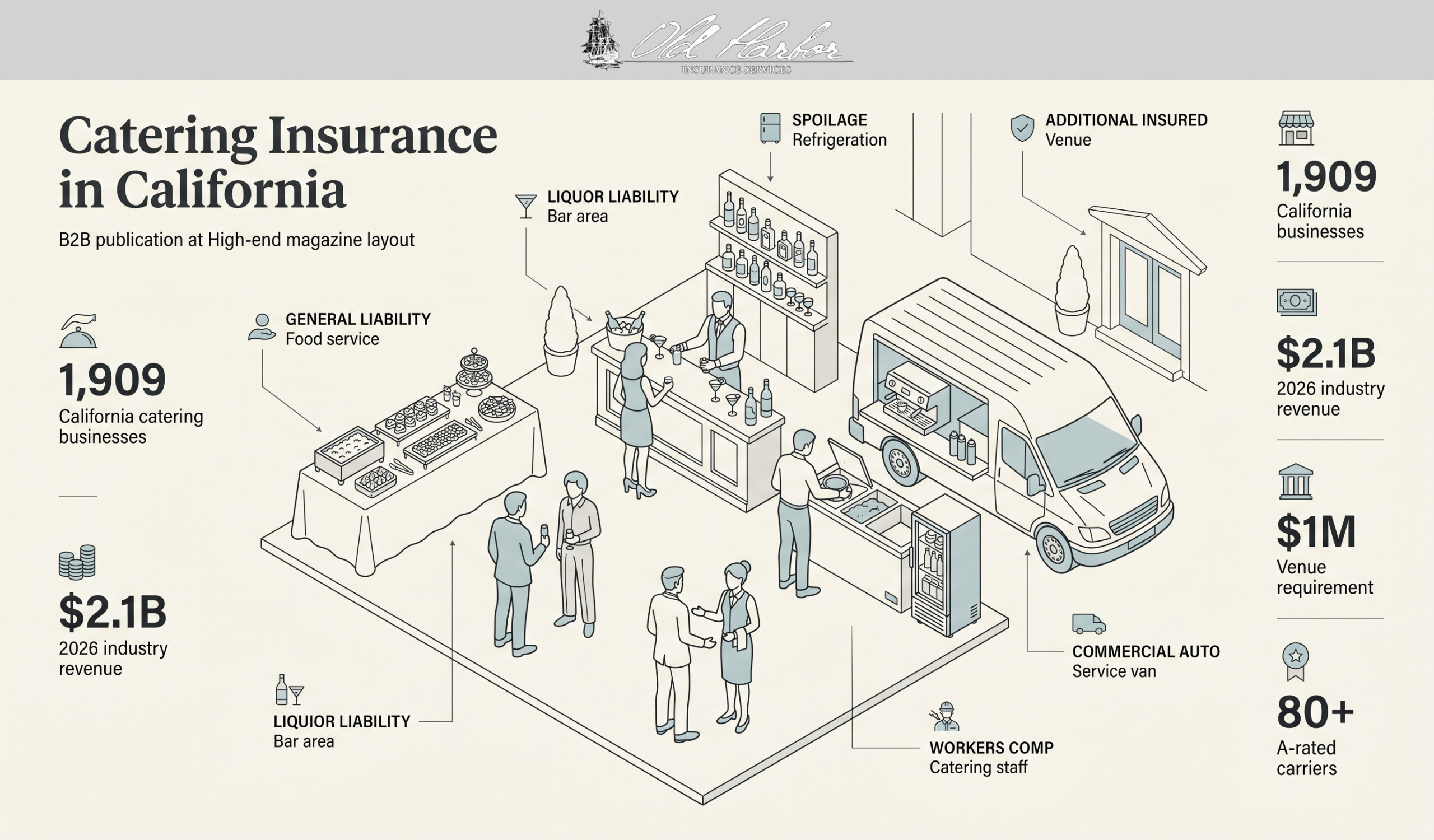
What Catering Insurance Covers in California
Coverage at a Glance
- General liability: Property damage or injury at a venue, and foodborne illness claims
- Liquor liability: Claims tied to alcohol served or poured at an event
- Commercial auto: Vehicles transporting food, staff, and equipment to and from events
- Property and inland marine: Kitchen equipment, chafing dishes, and rented gear in transit or on-site
- Workers’ compensation: Required for catering staff, including part-time and event-day hires
- Product liability: Contamination or spoilage that reaches a guest
General Liability and Foodborne Illness Claims
General liability is the base layer most venues ask to see proof of before letting a caterer on-site, and it typically covers both property damage during setup or breakdown and liability claims tied to food that made someone sick.
That second piece is worth confirming rather than assuming, since some general liability forms sublimit or exclude foodborne illness claims unless a specific endorsement is added, and a caterer serving hundreds of guests at once carries more exposure per event than a typical restaurant serving the same number of covers across a full week.
Liquor Liability and the Type 58 Catering Permit
Serving alcohol at an event adds liquor liability to the coverage list, and the underlying licensing is more restrictive than most caterers expect. California’s Type 58 catering permit only extends to certain existing on-sale licensees, including on-sale general, on-sale beer and wine, and a handful of other license types, capped at 36 catered events per year at any one location, with a separate ABC authorization required for each event.
A caterer without one of those underlying licenses typically pours under a venue’s own license or partners with a licensed caterer instead of holding the authorization directly. Either way, liquor liability insurance is what responds if an over-service claim comes in, and that need doesn’t go away just because someone else’s license is what authorized the pour.
Equipment, Rentals, and Auto Coverage in Transit
A catering business moves a lot of value between its commissary kitchen and an event site: chafing dishes, linens, rented china, and the food itself, often in a van that’s also carrying staff. Commercial auto covers the vehicle and the liability of driving it, but a refrigeration failure that spoils a van full of food, or rented equipment damaged in transit, needs its own inland marine or spoilage coverage rather than relying on the auto policy to stretch to fit.
Business Income and Event Cancellation
A kitchen fire, refrigeration failure, or utility interruption can stop several booked events at once. Business-income coverage can replace lost income when operations halt because of a covered property loss, while extra-expense coverage can help pay for a temporary licensed kitchen or rented equipment.
Event-cancellation coverage addresses a different problem and is not automatically included. Caterers that accept large deposits or commit to nonrefundable food and rental costs should review which causes of cancellation are covered, how client refunds are handled, and whether wildfire smoke, weather, or venue closure is excluded.
Why California Caterers Face Distinct Insurance Risks
Every Venue Wants Its Own Certificate of Insurance
Wedding venues, corporate offices, and event planners routinely require a certificate of insurance naming them as an additional insured before a caterer is allowed on-site, often with a minimum general liability limit of $1 million per occurrence or higher. A caterer whose policy sits below what a venue requires can lose the booking entirely, or scramble for a last-minute endorsement, which is easier to avoid by matching coverage limits to what venues in the caterer’s market typically ask for before the busy season starts.
County Health Permits Tie Directly Into Liability
A caterer operating out of a permitted commissary kitchen, with staff carrying current food handler cards, presents a different underwriting picture than one working out of an uninspected home kitchen. California generally requires most food handlers to complete an approved food safety course within 30 days of hire, and county health departments issue the permits that govern where food can legally be prepared for sale.
Underwriters look at both when pricing general liability and product liability, since a permitted operation with trained staff is a materially different risk than one operating outside those requirements.
Temporary Staff and Hired Labor
A caterer may use employees, staffing-agency workers, or independent servers at the same event, but those labels do not always settle who is responsible for an injury. Underwriters will ask who recruits the workers, controls their shifts, supplies equipment, and carries workers’ compensation.
Written staffing agreements and current certificates of insurance help establish which company is expected to respond. They also reveal gaps before an event, especially when a caterer directs agency workers closely enough to create a possible co-employment issue.
How Much Does Catering Insurance Cost in California?
Annual revenue and number of events per year move the price the most, alongside whether the business serves alcohol, hires event-day staff through a third party, and how much equipment value rides in company vehicles. A caterer that only drops off trays carries a different profile than one running full-service events with a bar and rented décor, even at similar revenue.
How Old Harbor Insurance Helps
A catering business’s coverage often needs to keep pace with growth that happens quickly: adding a liquor license, hiring event staff, or scaling from drop-off orders to full-service weddings all change what a policy needs to cover. Old Harbor Insurance works with more than 80 A-rated carriers, comparing coverage instead of settling for whatever a single company offers a growing catering business. How a business liability claim moves from filing to payout is worth understanding before a venue’s certificate-of-insurance request turns into an actual claim.
Get Your Catering Business Properly Covered
A policy written for a smaller drop-off operation rarely still fits once a caterer adds bartending, event staffing, or full-service weddings to the business. Contact Old Harbor Insurance to review coverage against how the business operates today, or request a quote to compare general liability, liquor liability, and equipment coverage across multiple carriers.
Frequently Asked Questions
Does general liability insurance cover a foodborne illness claim from a catered event?
It often does, but some policies sublimit or exclude foodborne illness claims unless a specific endorsement is added, so it’s worth confirming rather than assuming a standard general liability policy responds fully. A caterer serving large volumes at single events should size that coverage with the number of guests per event in mind, not just annual revenue.
Do caterers need their own liquor license to serve alcohol at a private event?
Not always. California’s Type 58 catering permit is only available to businesses that already hold certain on-sale licenses, so many caterers instead pour under a venue’s existing license or partner with a licensed caterer for events involving alcohol. Liquor liability insurance still matters in either arrangement, since it covers the caterer’s own exposure regardless of whose license authorized the alcohol service.
Does a venue’s own insurance cover a caterer’s equipment or staff at an event?
No. A venue’s policy covers its own property and operations, not a caterer’s equipment, food, or employees, which is exactly why most venues require caterers to carry their own coverage and name the venue as an additional insured before the event.
Does commercial auto insurance cover food that spoils in transit due to a refrigeration failure?
No. Commercial auto covers the vehicle and driving liability, not the food or equipment inside it. Spoilage from a refrigeration failure in transit typically needs its own inland marine or spoilage coverage rather than relying on the auto policy.
Are event-day servers hired through a staffing agency covered under the caterer’s workers’ compensation policy?
Usually the staffing agency’s own workers’ compensation applies if the staffing is properly structured, but a caterer that directs and supervises those workers closely enough can create a co-employment question. Confirming how the staffing arrangement is documented, rather than assuming the agency’s coverage automatically applies, avoids a dispute if someone is hurt working an event.
Does a caterer that only uses a client’s own kitchen still need the same insurance?
Yes, general liability, liquor liability if alcohol is served, and workers’ compensation for staff still apply regardless of whose kitchen prepares the food. What can differ is the health permitting picture, since cooking in a client’s private kitchen raises different questions than operating out of a permitted commercial or commissary kitchen.
Does catering insurance cover a cancellation caused by rain, wildfire smoke, or a venue closure?
Catering insurance does not automatically reimburse every weather-related or venue cancellation. Event-cancellation or business-income coverage may respond only when the cause is covered and the policy’s waiting period, exclusions, and documentation requirements are satisfied, so caterers should not promise clients that every canceled event is insured.