
Surplus lines insurance in California gives brokers a lawful way to place risks that admitted insurers will not accept or cannot cover in the form the customer needs. It is part of the private insurance market, not a government program and not another name for the California FAIR Plan. Old Harbor Insurance uses surplus lines access when a property’s location, value, occupancy, loss history, construction, or unusual exposure falls outside standard carrier guidelines. The market can address both residential and commercial accounts, from wildfire-exposed estates to vacant buildings and specialized businesses.
The route can preserve broader private-market options, but it comes with different protections, taxes, forms, and policy language. Old Harbor can compare surplus lines possibilities after the admitted market declines, with attention to the insurer behind the policy and the coverage that is being offered rather than the label alone. A workable quote should solve the reason for the declination without creating a less obvious gap elsewhere.
What Surplus Lines Insurance Means in California
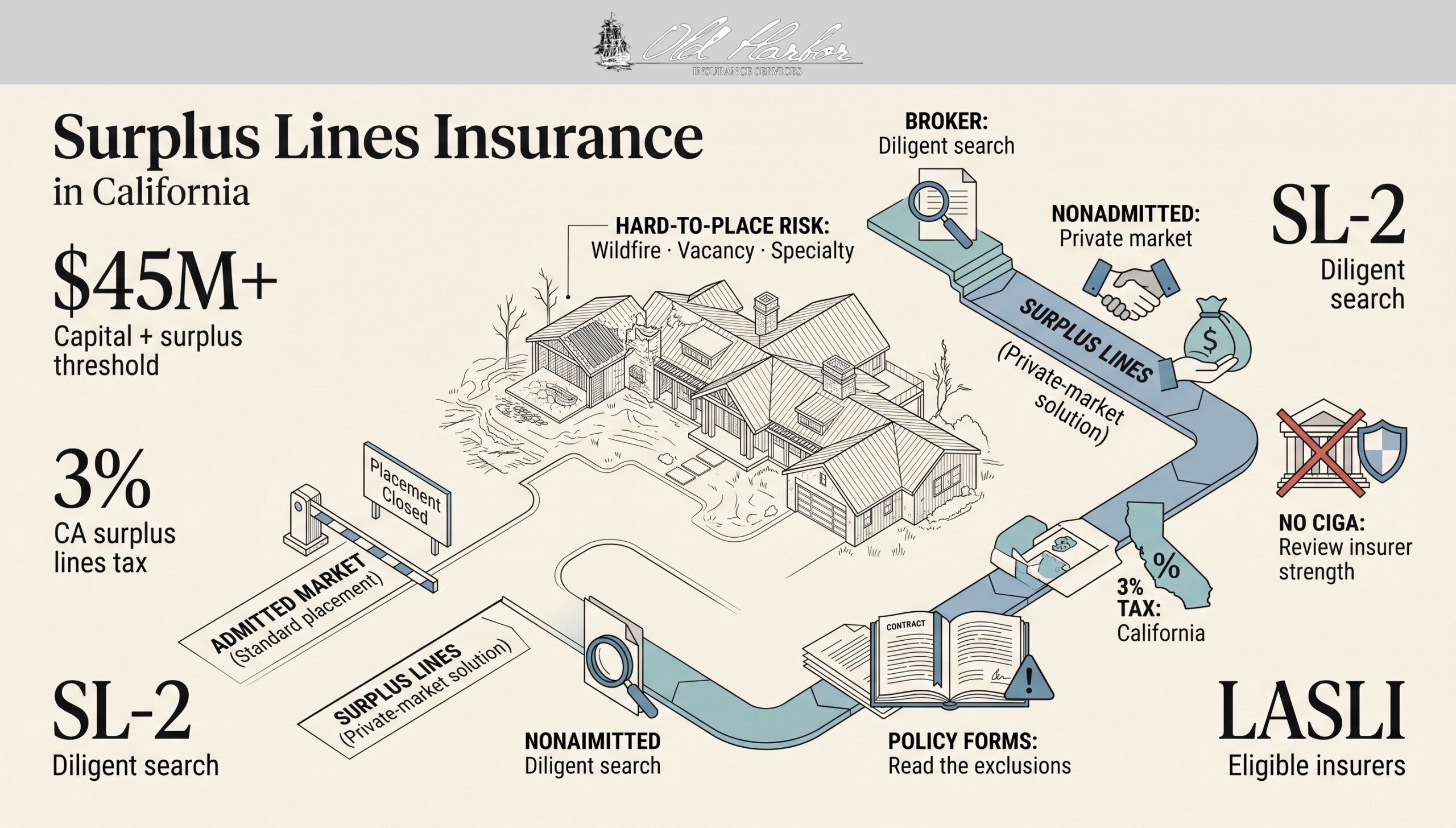
A surplus lines insurer is “nonadmitted,” meaning it is not licensed as an admitted insurer in California even though it is licensed in its home jurisdiction and may be eligible to accept California placements. The Surplus Line Association of California’s explanation distinguishes U.S.-domiciled foreign insurers from non-U.S. alien insurers and describes the eligibility rules brokers must follow.
Nonadmitted Does Not Mean Unregulated
California regulates the broker, the placement process, taxes, disclosures, and insurer eligibility. An insurer may appear on the List of Approved Surplus Line Insurers, known as LASLI, or qualify under another statutory eligibility route. The SLA’s insurer requirements state that qualifying U.S. insurers generally need at least $45 million in capital and surplus unless an exception applies.
Rates and forms in the surplus market are not reviewed in the same way as admitted products. That flexibility lets insurers address unusual or fast-changing risks, but it also places more weight on the broker’s comparison of exclusions, deductibles, valuation, and claims provisions.
The California Insurance Guarantee Association Does Not Back the Policy
Admitted property and casualty policies may qualify for protection from the California Insurance Guarantee Association if a member insurer becomes insolvent, subject to statutory limits and exclusions. Surplus lines policies do not receive that CIGA protection. The financial strength, domicile, reinsurance, ownership, and claims reputation of the nonadmitted insurer therefore deserve direct review.
California’s approval standards are substantial. Insurance Code section 1765.2 addresses financial stability, reputation, licensing in the home jurisdiction, filing obligations, and the commissioner’s authority to remove an insurer from LASLI.
How a Risk Reaches the Surplus Lines Market
Surplus lines is generally a secondary route, not the first stop for an ordinary risk. A licensed retail agent or broker identifies the exposure, approaches admitted markets that might reasonably write it, and works with a surplus lines broker or wholesaler when those markets decline or cannot supply the needed coverage.
The Diligent Search and SL-2 Form
The Diligent Search Report, commonly called the SL-2, documents the effort to place a risk with admitted insurers. The report records the declining carriers and information about the proposed nonadmitted placement. Certain coverage types on California’s Export List can move to surplus lines without the ordinary diligent-search requirement.
A declination is not always a rejection of the owner. It may reflect a carrier’s current concentration in a ZIP code, wildfire model, roof-age rule, rebuilding limit, vacancy appetite, or temporary restriction on new business. The surplus submission should explain the actual risk rather than forwarding an incomplete standard-market application.
The Broker Still Has to Test the Policy
Surplus lines forms can differ materially from familiar homeowners or commercial forms. Named-peril coverage, wildfire deductibles, roof schedules, cosmetic-damage exclusions, water limits, vacancy restrictions, minimum earned premium, inspection conditions, and protective-device warranties all require review.
The declarations page cannot answer every coverage question. Reading the forms and endorsements before binding makes property-claim expectations clearer and reduces the chance that a low premium hides a narrow trigger or sublimit.
Risks Commonly Placed Through Surplus Lines in California
The market is used for both personal and commercial risks that fall outside admitted guidelines. Common examples include high-value homes in wildfire areas, vacant dwellings, major renovations, unusual construction, coastal properties, older electrical systems, prior losses, short-term rentals, cannabis businesses, special events, and difficult commercial occupancies.
Hard-to-Place Homes and Estates
A private insurer may accept a wildfire-exposed home that the admitted market declines, sometimes with a larger deductible, inspection, vegetation requirements, or a narrower form. High-value programs may also address rebuilding limits above the FAIR Plan’s residential cap and provide coverage for valuables, equipment, or liability under coordinated policies.
Eligibility changes by address and renewal date. A carrier willing to insure one home on a road may decline another because of slope, access, roof, brush, replacement cost, or modeled accumulation.
Vacant, Renovated, and Nonstandard Properties
Vacancy removes the daily supervision that helps detect leaks, fire, trespass, and vandalism. Renovation adds open walls, temporary wiring, contractors, materials, and changing values. Surplus lines markets can write forms designed for those conditions rather than forcing the risk into an occupied-home policy that may restrict coverage.
The owner must describe occupancy and work accurately. A policy written for a furnished seasonal residence is not automatically suitable for an empty house under structural renovation.
Cost, Taxes, and Payment Terms
California imposes a 3 percent surplus lines premium tax. Revenue and Taxation Code section 13210 applies the tax to gross premiums for covered nonadmitted placements, subject to the statute’s adjustments and exceptions. A policy may also include stamping, inspection, broker, or policy fees.
Premium is often fully earned or subject to a minimum earned percentage once coverage begins. Financing can add interest and cancellation terms. A lower annual number is not necessarily cheaper if one policy excludes water, provides actual-cash-value roof settlement, or carries a large wildfire deductible while another does not.
Questions to Ask Before Binding Surplus Lines Coverage
- Which insurer issues the policy, and where is it domiciled?
- Is the insurer on LASLI or eligible through another California route?
- What diligent search or Export List rule applies?
- Which perils are covered, limited, or excluded?
- Are wildfire, water, roof, vacancy, or cosmetic-damage deductibles separate?
- Is replacement cost conditional on rebuilding, and are losses settled in stages?
- What premium is earned if the policy is cancelled early?
- Which taxes and fees sit outside the quoted base premium?
These questions matter more than whether the quote is called specialty, excess and surplus, or nonadmitted. The binding documents and policy forms control.
How Old Harbor Insurance Helps
Old Harbor Insurance can approach admitted carriers first, document the market response, and reach specialty options when the standard path closes. The submission can include reconstruction estimates, mitigation records, photographs, occupancy details, inspections, and a clear explanation of unusual exposures.
The agency also compares the surplus offer with alternatives such as an admitted policy, a FAIR Plan and DIC combination, or a narrower temporary placement. The best route depends on the property, lender requirements, available limits, and the exclusions the owner can reasonably accept.
Compare the Policy, Not Merely the Premium
Surplus lines insurance can solve a difficult placement, but only when the form matches the risk. Contact Old Harbor Insurance to review a declined or non-renewed account, or request a quote to compare available private-market options.
Frequently Asked Questions
Can a mortgage lender accept surplus lines homeowners insurance?
A mortgage lender can accept surplus lines coverage when the policy meets the loan’s hazard-insurance requirements. The borrower should confirm the insurer, dwelling limit, mortgagee wording, deductible, and effective dates before binding.
Can a consumer buy surplus lines insurance directly from the insurer?
California surplus lines coverage is placed through properly licensed brokers rather than purchased directly as an ordinary admitted policy. A retail agent may work with a wholesale surplus lines broker to reach the insurer.
Does California cap surplus lines insurance rates?
Surplus lines rates are not subject to the same prior-approval process used for admitted policies. Competition and underwriting judgment shape pricing, which makes form and fee comparison particularly important.
Can a surplus lines insurer cancel or non-renew a policy?
A surplus lines insurer can cancel or non-renew according to the policy and applicable California rules. Notice provisions may differ from an admitted homeowners policy, so the cancellation endorsement should be reviewed when coverage is placed.
Is Lloyd’s of London a single surplus lines insurance company?
Lloyd’s is an insurance marketplace whose syndicates underwrite risks; it is not one insurance company. The policy documents identify the participating syndicate or underwriters responsible for the placement.
Can surplus lines coverage later move back to an admitted carrier?
A surplus lines account can return to the admitted market if appetite, property conditions, or underwriting information changes. Owners should review options at renewal rather than assuming the initial placement is permanent.
Are claims handled differently under a nonadmitted policy?
Nonadmitted insurers still investigate and adjust claims under the contract, but policy forms and service arrangements vary. The declarations, claims contact, governing endorsements, and proof requirements should be stored before a loss.