

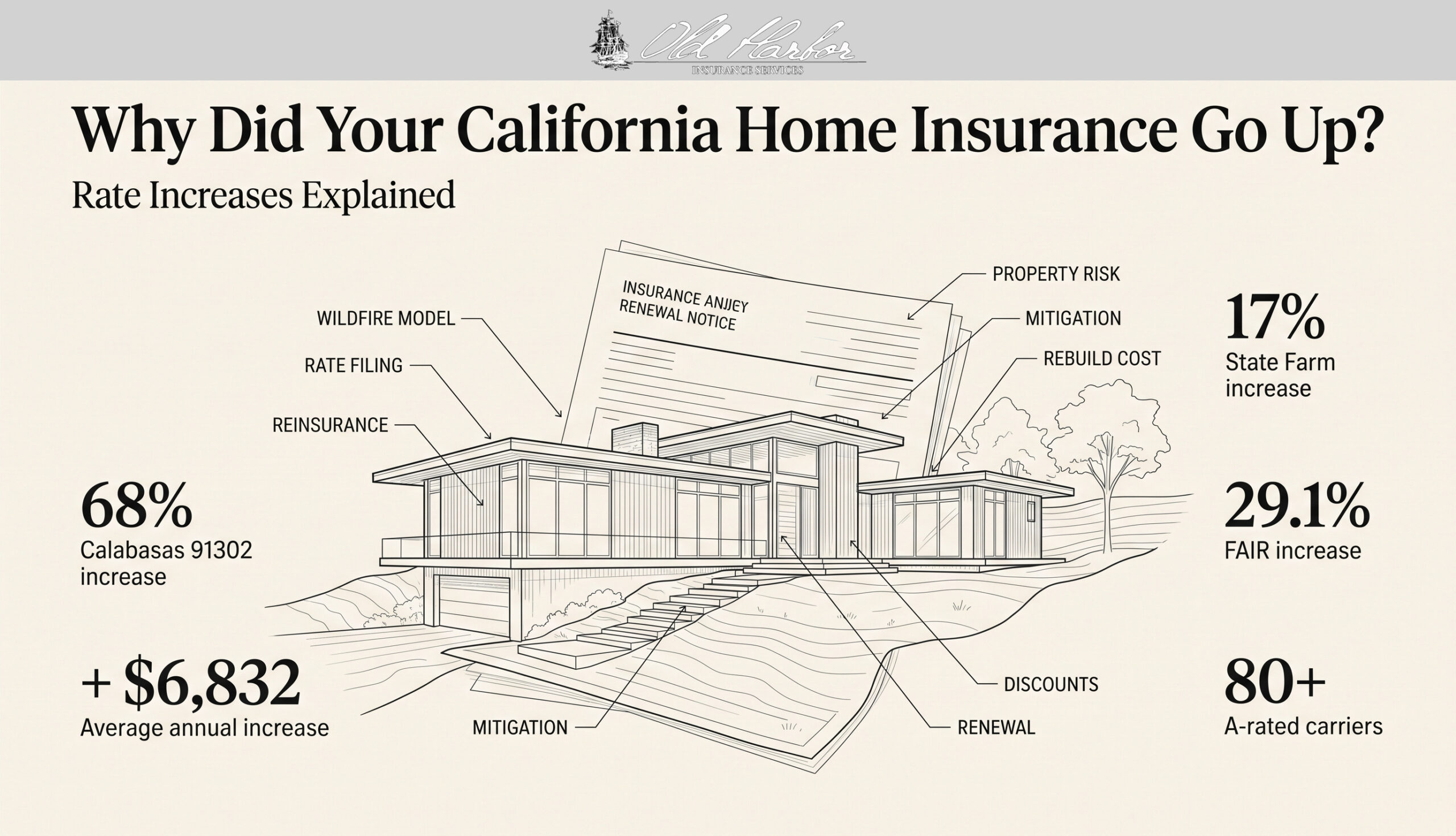
A 40 percent jump in a single renewal notice sounds extreme, but it’s within the range some California homeowners have genuinely seen. State Farm’s already-approved rate increase pushed premiums in Calabasas’s 91302 ZIP code up an average of 68 percent, or $6,832 a year, by 2025 compared with 2023, according to an analysis of the carrier’s own filings by the Center for Climate Integrity. Old Harbor Insurance fields this exact question from homeowners whose renewal notice landed nowhere near what last year’s bill said, and the honest answer is that the increase is probably real, even where it looks arbitrary at first glance.
The increase is not necessarily arbitrary. California rates still move through the Proposition 103 review process, while the Sustainable Insurance Strategy changed which forward-looking risk and reinsurance information insurers may use. Carrier-wide filings, property-level risk, reconstruction costs, discounts, and coverage changes can all contribute to the number on one renewal. If the notice still does not add up after that comparison, Old Harbor can help separate the carrier-wide increase from property-specific changes and compare available alternatives.
California’s Rate-Setting Process Changed in 2023
Before Insurance Commissioner Ricardo Lara’s Sustainable Insurance Strategy, insurers could only use historical loss data to set wildfire rates, which meant premiums spiked hard right after a major fire and some companies pulled back from the state entirely rather than price the risk going forward. Lara’s reforms, described by United Policyholders as the most extensive overhaul of California’s insurance regulations in nearly 35 years, now let insurers use forward-looking catastrophe models, current reinsurance costs, and wildfire mitigation data when they file for a rate change.
In exchange, the twelve largest insurers have to write 85 percent of their statewide new-business market share in historically underserved, high-risk areas, and the CDI is building its own public wildfire catastrophe model with Cal Poly Humboldt to serve as a benchmark against insurer-submitted models.
Catastrophe Models, Reinsurance, and Mitigation Data
The new framework does not produce one uniform statewide increase. Each insurer still files its own rates, and the approved result depends on that carrier’s portfolio, catastrophe-model output, reinsurance costs, and proposed commitments in underserved areas. Those portfolio-level changes then interact with the characteristics of an individual property.
The reforms also require wildfire models to account for recognized mitigation measures. That creates a practical reason to verify that a carrier has current documentation for home-hardening work, because the model cannot credit an improvement the insurer does not know about.
How Large Recent California Rate Increases Have Been
The size of the increase varies enormously by carrier, and each one goes through its own public filing and review. State Farm was approved for a 17 percent statewide homeowners increase following the January 2025 Los Angeles wildfires, then asked for more in May 2025.
A three-party settlement between State Farm, the California Department of Insurance, and Consumer Watchdog, finalized in March 2026, held the homeowners increase at 17 percent while adjusting related lines: rental dwelling settled at 32.8 percent instead of the 38 percent originally requested, condo coverage settled at 5.8 percent instead of 15 percent, and renters insurance ticked up to 15.65 percent, according to Insurance Journal’s coverage of the settlement.
Other carriers have landed in very different places. Farmers requested a 6.99 percent increase and was approved for 1.5 percent statewide for roughly 915,000 policyholders, effective on renewals starting September 15, 2026, according to reporting on the approved filing.
Regulators have also signed off on separate 2026 increases for Mercury, CSAA, and USAA, each reviewed on its own under the same Proposition 103 process. The California FAIR Plan, the state’s insurer of last resort, announced a 29.1 percent average rate increase of its own, effective October 2026.
Why Your Own Increase Might Be Bigger Than the Statewide Average
A statewide average headline number rarely matches what shows up on an individual renewal notice. A property’s specific wildfire risk score under the newer catastrophe models, whether documented mitigation work like defensible space or a Class A roof has been submitted to the carrier, and bundling status with auto or umbrella coverage can all push one household’s increase well above or below the average the news reports.
Two homes a few miles apart, similar age and value, can land on very different renewal numbers once one carries a higher modeled wildfire score than the other.
How to Review a California Home Insurance Renewal
Separate the Base Rate From Property-Specific Changes
Start with the declarations page from the expiring policy and compare it line by line with the renewal. Look at the dwelling limit, other-structures and personal-property limits, deductible, endorsements, and every listed discount. A carrier-wide approved rate change may explain part of the increase, while an updated replacement-cost estimate, wildfire score, or loss history explains another part.
Ask the carrier or agent for the rating factors behind the renewal rather than relying only on the total premium. The useful question is not merely whether rates went up, but which inputs changed for this property and whether the carrier used complete mitigation information.
Check Coverage Limits Before Cutting the Premium
Raising a deductible or removing an endorsement can reduce the bill, but it also transfers more of the next loss to the homeowner. Before changing coverage, confirm that the dwelling limit still reflects current reconstruction costs and that ordinance or law coverage accounts for code upgrades that may be required after a major loss.
Documented mitigation may also affect eligibility or pricing. Keep receipts, photographs, inspection reports, and contractor records for roof work, vents, defensible space, or other improvements, then ask how the carrier accepts and evaluates that evidence.
How Old Harbor Insurance Helps
A rate increase is a good moment to check whether the current carrier is still the most competitive option, rather than simply paying the new number. Old Harbor Insurance works with more than 80 A-rated carriers, comparing what a specific property would pay elsewhere instead of assuming the increase is universal. What to do if a policy gets canceled or non-renewed is worth reading alongside this, since a steep enough increase sometimes comes paired with a non-renewal notice instead.
Get a Second Opinion on Your Renewal
A renewal notice with a number that doesn’t match last year’s bill is worth a second look before it’s simply paid. Contact Old Harbor Insurance to review what’s driving a specific increase, or request a quote to compare current pricing across multiple carriers.
Frequently Asked Questions
Is a 40 percent single-year increase legal in California without special approval?
An increase of that size still has to go through the same Proposition 103 public rate hearing process as a smaller one, and a large increase typically draws more scrutiny and takes longer to finalize, sometimes a year or more, as State Farm’s 2025 to 2026 filing showed.
Can a homeowner dispute or intervene in a rate increase before it’s approved?
Yes. Proposition 103 allows public comment on pending rate filings, and organized intervenors like Consumer Watchdog regularly participate in the hearing process, as they did in the State Farm settlement finalized in March 2026. An individual homeowner can submit comments to the California Department of Insurance on a pending filing, though most rate outcomes are ultimately shaped by these larger, organized proceedings.
Does switching to a new insurance carrier reset how wildfire risk is scored on my home?
No. Wildfire risk scoring under the new catastrophe models is tied to the property and its location, not to how long a homeowner has held a policy with a given carrier. A new carrier prices the same underlying risk, though mitigation credits, bundling discounts, and underwriting appetite can still differ from one company to the next.
Does documenting wildfire mitigation work lower a rate increase?
It can. The Sustainable Insurance Strategy requires insurers using catastrophe models to factor in documented fire-resistance improvements, which is a meaningful change from the old approach of pricing almost entirely off historical losses. Submitting proof of defensible space, ember-resistant vents, or a Class A roof to a carrier is worth doing before a renewal, not after.
Will home insurance rates in California go back down once these reforms fully phase in?
That’s not yet clear. CDI officials have suggested relief could follow once more insurers return to writing new policies and the market stabilizes, but no firm timeline has been set, and increases have continued through 2025 and 2026 as the reforms take effect.
Does the FAIR Plan’s rate increase affect a standard admitted-market policy too?
No. The FAIR Plan’s rate filings apply only to its own policyholders. A standard admitted carrier’s rate increase goes through its own separate filing, though FAIR Plan growth and pricing do factor into the broader market conditions regulators consider when reviewing admitted carriers’ requests.
Can my premium rise even if my carrier’s base rate did not change?
Yes. A premium can increase because the dwelling limit was adjusted for construction inflation, a discount changed, a deductible was revised, or the carrier updated property-level rating information. Comparing the declarations pages from both terms helps separate those changes from a carrier-wide rate increase.