

Most California homeowners on the FAIR Plan have been told they need a DIC policy — but very few have had anyone explain why, what it actually covers, or how claims work when both policies are in play. That gap in understanding matters most after a loss, when the distinction between what the FAIR Plan pays and what the DIC carrier pays determines how quickly and completely you recover. As of early 2026, the FAIR Plan held roughly 668,000 active policies — up from approximately 154,000 in 2019 — and the number of Californians navigating this two-policy structure has grown accordingly.
Old Harbor Insurance places both FAIR Plan policies and DIC coverage for California homeowners, and helps clients understand exactly how the two work together before they need to file a claim.
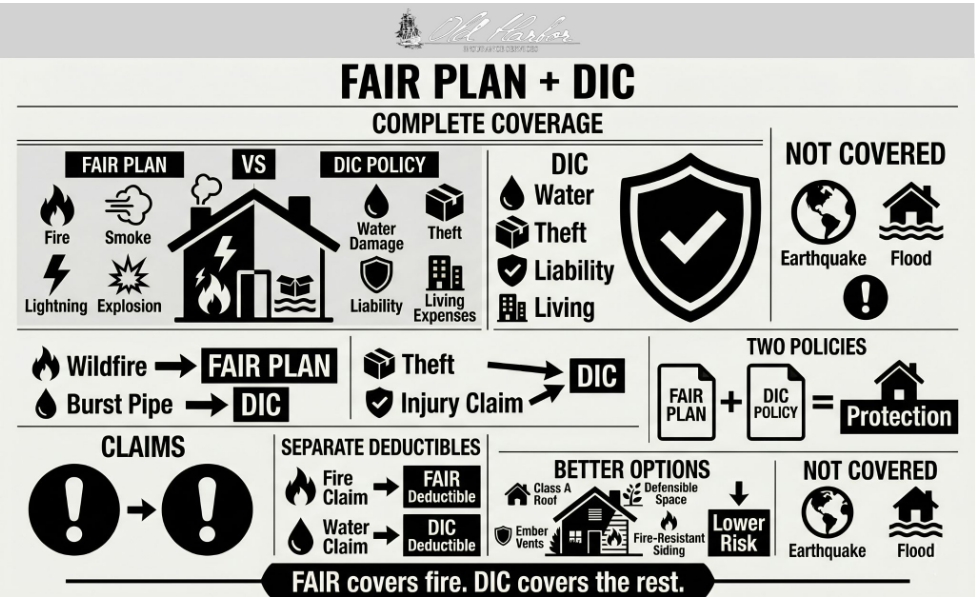
What the FAIR Plan Actually Covers
The California FAIR Plan is the state’s insurer of last resort — available to homeowners who cannot obtain coverage in the voluntary market. Its standard policy covers four named perils: fire, smoke, lightning, and internal explosion. Optional endorsements can add vandalism, windstorm, and a small number of other perils for an additional premium.
According to the FAIR Plan’s own policies page, this is the full extent of standard coverage. Flood, earthquake, theft, water damage, liability, and additional living expenses are all excluded. The FAIR Plan was never designed to function as a comprehensive homeowners policy — and the California Department of Insurance explicitly describes it as a last-resort option for homeowners in high-risk areas who cannot access the voluntary market.
What a DIC Policy Is — and What It Isn’t
According to the FAIR Plan’s own DIC guidance, a Difference in Conditions policy provides coverages not available through the FAIR Plan — including water damage, theft, and liability — and is designed to combine with a FAIR Plan policy to provide protection similar to a comprehensive homeowners policy. The FAIR Plan does not sell DIC policies itself. They are issued by separate insurers through licensed brokers.
DIC Is Not a Standard Product
This is one of the most important things FAIR Plan policyholders need to understand: there is no standardized DIC policy in California. Coverage terms, exclusions, deductibles, and limits vary widely by carrier and underwriting appetite.
The California Department of Insurance maintains a list of carriers that offer DIC products designed to complement FAIR Plan coverage, but the specific terms of each policy must be reviewed carefully. A DIC policy from one carrier may include water backup coverage; another may not. One may carry a flat deductible; another may apply a percentage-based deductible on certain perils.
DIC Is a Separate Policy With Its Own Claims Process
A DIC policy is issued by a different insurer, carries its own deductible, and has its own claims process. It is not an endorsement on the FAIR Plan — it is an independent policy that must be managed alongside the FAIR Plan, not instead of it. When a loss occurs, determining which policy responds first requires understanding the specific peril involved and how each policy defines its coverage scope.
How Claims Actually Work With Both Policies
This is where most explanations stop short. Understanding which policy responds to which loss before a claim happens prevents delays, disputes, and gaps in recovery after one.
| Loss Type | Which Policy Responds |
| Wildfire destroys home | FAIR Plan |
| Burst pipe damages kitchen | DIC policy |
| Theft of personal property | DIC policy |
| Liability lawsuit from guest injury | DIC policy |
| Hotel stay after covered fire loss | May depend on DIC terms |
| Smoke damage from neighbor’s fire | FAIR Plan (fire/smoke peril) |
| Vandalism (if endorsed) | FAIR Plan (with endorsement) |
| Earthquake damage | Neither — requires separate policy |
| Flood damage | Neither — requires separate policy |
The general rule: fire, smoke, lightning, and internal explosion go to the FAIR Plan. Water damage, theft, liability, and additional living expenses go to the DIC carrier. In practice, some losses straddle the line — a fire that also causes water damage from sprinkler systems, for example — and the interaction between the two policies determines how that claim is processed. Understanding how claims are handled under each policy type before a loss is essential.
Why Mortgage Lenders Care About DIC Coverage
FAIR Plan-only coverage creates a problem for homeowners with mortgages. Standard homeowners policies include liability protection, replacement cost coverage, and additional living expenses as components lenders typically require. The FAIR Plan satisfies the basic dwelling protection requirement but does not include liability coverage — a gap that most lenders will flag when reviewing insurance documentation.
According to United Policyholders’ FAIR Plan consumer guide, homeowners using the FAIR Plan should ensure their combined FAIR Plan plus DIC coverage meets the requirements specified in their loan documents. Tell escrow early if two policies are involved — waiting until the final loan condition creates unnecessary delays when one insurer’s documentation arrives before the other. Lenders generally accept the two-policy structure when dwelling limits, mortgagee clauses, and DIC terms meet their requirements.
Coverage Gaps That Remain Even With DIC
A FAIR Plan plus DIC combination approximates the breadth of a standard HO-3 homeowners policy — but it doesn’t replicate it completely. Two significant gaps remain regardless of how the DIC is structured:
Earthquake: Both the FAIR Plan and DIC policies exclude earthquake damage as standard. Earthquake coverage requires a separate policy, typically through the California Earthquake Authority. For California homeowners in seismically active areas, this gap is real and consequential.
Flood: Flood damage from external water sources is excluded from both the FAIR Plan and standard DIC policies. The FEMA National Flood Insurance Program provides coverage for flood-related structural damage and contents, available to homeowners regardless of flood zone designation.
High-value personal property — jewelry, art, collectibles, instruments — may also face sub-limit constraints in DIC policies, just as they do in standard homeowners policies, unless specifically scheduled.
How Home Hardening Affects Long-Term Options
The FAIR Plan and DIC combination is designed as a temporary structure, not a permanent solution. The Insurance Institute for Business and Home Safety documents that ember intrusion through vents and roof vulnerabilities are the two primary wildfire ignition pathways — the same factors that drive insurer underwriting decisions about which properties to write and at what price.
California’s Safer from Wildfires framework requires admitted insurers to offer premium discounts for documented mitigation improvements: Class A fire-resistant roofing, ember-resistant vents, 100 feet of defensible space, and fire-resistant siding. These improvements shift a property’s risk profile in carrier underwriting models — and for homeowners on FAIR Plan plus DIC, they represent the most direct path back to standard admitted market coverage where rates are regulated and CIGA insolvency protection applies.
How Old Harbor Structures FAIR Plan + DIC Coverage
Placing a FAIR Plan plus DIC combination that genuinely approximates standard coverage requires reviewing both policies together — not just confirming each exists. Old Harbor Insurance reviews dwelling limits, DIC exclusions, deductible structures, and liability limits across both policies to ensure there are no gaps at the seams where the two interact. The CDI’s residential insurance resources provide consumer guidance on policy comparisons and coverage reviews that inform how we approach each placement.
Contact us to review your current FAIR Plan plus DIC structure. Get a quote to compare real options for your property.
Frequently Asked Questions
Does a DIC policy replace the FAIR Plan?
No. A DIC policy supplements the FAIR Plan — it fills the gaps the FAIR Plan leaves rather than replacing its fire coverage. The two policies operate independently, with separate insurers, separate deductibles, and separate claims processes. Both are required to approximate the breadth of a standard homeowners policy.
Is theft covered by the FAIR Plan?
Not under the standard policy. Theft is a DIC coverage. If you carry a FAIR Plan without a DIC policy, a theft claim will not be covered by either policy. This is one of the most common coverage gaps homeowners discover after a loss rather than before one.
Can I buy a DIC policy without the FAIR Plan?
Generally no. DIC policies are specifically designed to complement the FAIR Plan and exclude the perils the FAIR Plan covers — primarily fire, smoke, and lightning. They are not standalone homeowners policies and are not intended to function independently of a FAIR Plan placement.
How do separate deductibles work with both policies?
Each policy has its own deductible that applies to claims under that policy. A fire claim through the FAIR Plan is subject to the FAIR Plan’s deductible. A water damage claim through the DIC carrier is subject to the DIC policy’s deductible. The two deductibles are independent and do not offset each other. Reviewing both deductible structures together — not just one in isolation — is essential when evaluating total out-of-pocket exposure after a loss.
Do I still need flood insurance if I have FAIR Plan plus DIC?
Yes. Flood damage from external water sources is excluded from both policies. FEMA’s National Flood Insurance Program provides separate flood coverage, and private flood carriers offer alternatives with broader terms. The FAIR Plan plus DIC combination does not address this gap regardless of how the DIC is structured.
Are DIC policies standardized in California?
No. There is no standard DIC policy form in California. Coverage terms, exclusions, deductibles, and limits vary by carrier, location, and underwriting appetite. The California Department of Insurance maintains a list of carriers offering DIC products, but the specific terms of each policy must be reviewed individually rather than assumed to match.
Can I move off the FAIR Plan once I’m on it?
Yes. The FAIR Plan is designed as a temporary placement, not a permanent one. Documented wildfire mitigation improvements — roof replacement, ember-resistant vents, defensible space — improve eligibility with admitted carriers that may re-enter your market. An independent agent who re-shops your coverage annually is the most reliable way to identify when standard market options become available for your address.