

Force-placed insurance, sometimes called lender-placed insurance, is hazard coverage a mortgage servicer obtains when it believes the homeowner has allowed acceptable coverage to lapse. The borrower pays the premium, but the policy is designed primarily to protect the lender’s interest and may provide less protection than a standard homeowners policy. Old Harbor Insurance hears from California homeowners who discover the charge after a non-renewal, a FAIR Plan lapse, or a gap in the documents sent to the servicer.
Yes, a lender can force-place insurance in California, and the deed of trust signed at closing is generally what gives it the right to do so. Federal rules set a specific notice timeline before it can happen, and California adds its own limit on how much coverage a lender can require in the first place. If a force-placed charge has appeared or a coverage deadline is approaching, Old Harbor can help confirm what the servicer requires and identify replacement options.
Why a Mortgage Company Force-Places Insurance
A mortgage is secured by the property itself, and the deed of trust obligates the borrower to keep hazard insurance in place protecting the lender’s collateral for as long as the loan exists. When a servicer’s records show that coverage has lapsed, whether from a non-renewal, a cancellation for nonpayment, or a FAIR Plan policy that fell through, the loan agreement generally allows the servicer to buy a policy itself and charge the cost back to the borrower through the escrow account.
What Federal Law Requires Before It Happens
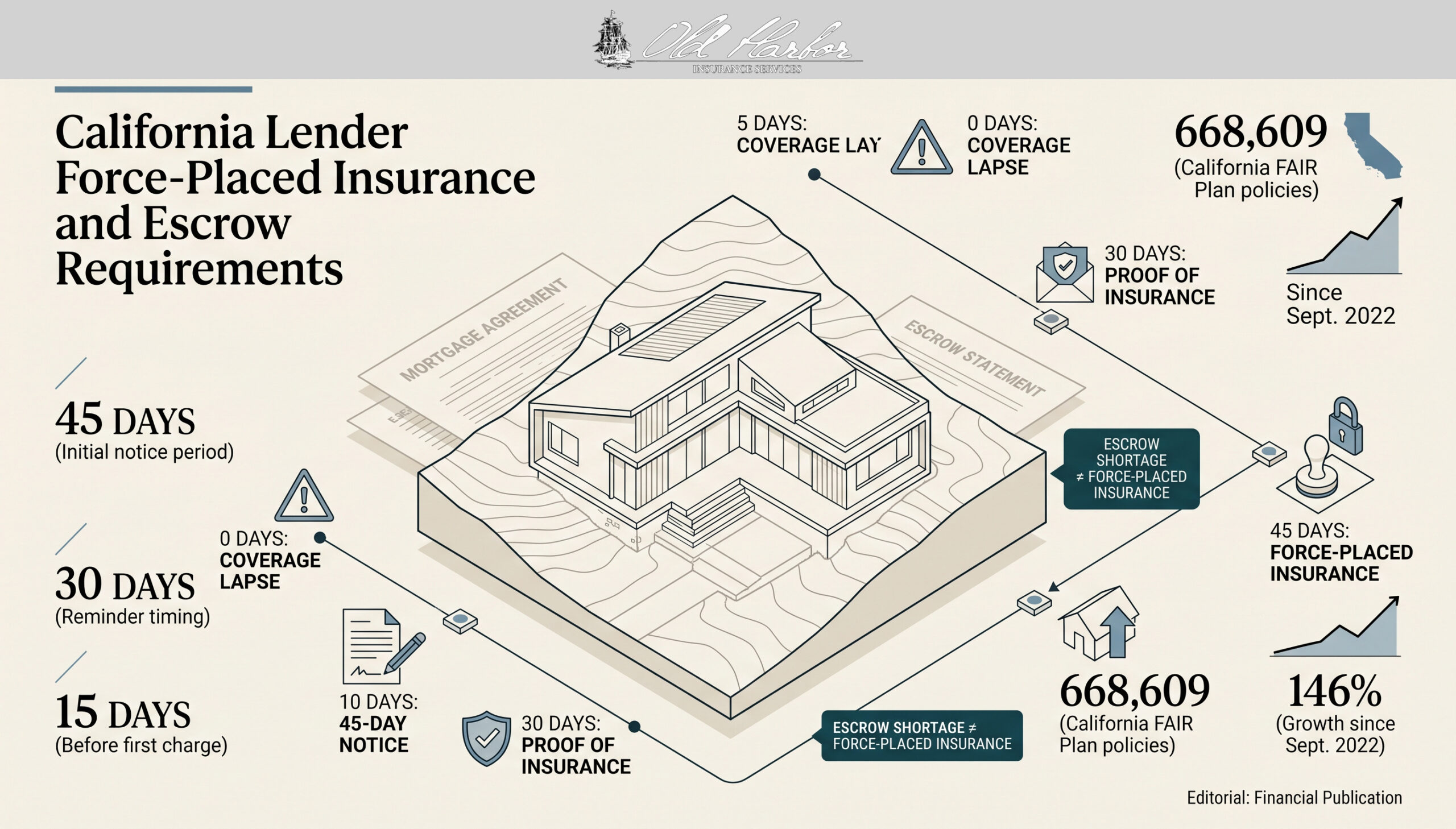
Force-placing insurance isn’t supposed to happen without warning. Under Regulation X, 12 CFR 1024.37, a mortgage servicer has to send a written notice at least 45 days before charging a borrower for force-placed insurance, explaining that hazard coverage appears to have lapsed and how to submit proof otherwise.
A second, reminder notice follows at least 30 days after the first and at least 15 days before the servicer can charge for the policy, and it has to include the estimated annual premium. If a borrower provides proof of existing coverage at any point, the servicer has 15 days to cancel the force-placed policy and refund every dollar charged for any period where the two policies overlapped.
Force-Placed Insurance Timeline
- Initial notice: At least 45 days before the servicer can charge for coverage
- Reminder notice: At least 30 days after the initial notice, at least 15 days before charging
- Force-placed policy purchased: Only if no proof of coverage is received by the deadline
- Proof of coverage provided afterward: Servicer must cancel the policy and refund overlapping premiums within 15 days
What Counts as Proof of Coverage
Federal rules require a servicer to accept evidence such as a declarations page, policy document, insurance certificate, or information supplied by the borrower’s insurer or agent when it demonstrates that hazard coverage is in force. The document should match the property address and show effective dates that close the alleged gap.
A borrower should submit proof through the method stated in the notice and keep a dated copy. If the servicer says the evidence is incomplete, ask what specific mortgagee clause, coverage amount, policy term, or other item is missing rather than repeatedly sending the same document.
California Adds Its Own Limit on What a Lender Can Require
California Civil Code Section 2955.5 caps how much hazard coverage a lender can require a borrower to carry in the first place: a lender can’t demand coverage exceeding the replacement value of the improvements on the property, and it has to disclose that limit in writing before the borrower signs the loan documents, according to the text of the statute.
That cap is worth checking against a force-placed policy specifically, since some force-placed coverage gets sized off a broader property valuation rather than the structure’s actual replacement cost, and a policy priced above what the statute allows is worth challenging.
An Escrow Shortage Is Not the Same as Force-Placed Insurance
An escrow shortage means the account does not contain enough money to pay projected taxes and insurance, often because the existing homeowners premium increased. Force-placed insurance means the servicer believes acceptable hazard coverage is missing and has purchased a separate policy on the lender’s behalf.
The two can appear on the same statement because a costly lender-placed premium may create or deepen an escrow shortage. Read the statement and notices carefully: replacing the insurance addresses the lender-placed policy, while the servicer’s escrow analysis determines how any remaining shortage is collected.
Why More California Homeowners Are Seeing This Charge Now
Force-placed insurance tends to show up more often during exactly the kind of market California has been in. The state’s FAIR Plan carried 668,609 policies as of December 2025, up 146 percent since September 2022, and homeowners moving between a non-renewed admitted policy and a replacement often have a narrower window than they realize before a lender’s own 45-day clock runs out.
What to do after a non-renewal is worth reading as soon as a cancellation notice arrives, rather than after a force-placed charge has already landed on an escrow statement.
What to Do After a Force-Placed Insurance Notice
Send Proof of Existing Coverage Immediately
If coverage never lapsed, send the declarations page or other permitted evidence through the servicer’s stated channel and keep confirmation of delivery. The proof should identify the property, policy term, insurer, and coverage amount. Follow up until the servicer confirms that its insurance records have been corrected.
If the servicer charged for days already covered by the homeowner’s policy, request cancellation of the force-placed policy and a refund for the overlapping period. Keep the notices, escrow statements, proof of insurance, and correspondence together in case the charge has to be disputed.
Replace Lapsed Coverage Before the Deadline
If the original policy did lapse, ask an independent agent to compare admitted-market, surplus-lines, and FAIR Plan options without waiting for the second notice. A binder or declarations page can then be sent to the servicer as evidence of replacement coverage.
The replacement policy must satisfy the mortgage agreement, not merely provide some fire coverage. Confirm the effective date, insured property, dwelling limit, mortgagee clause, and any deductible restrictions before assuming the servicer will accept it.
How Old Harbor Insurance Helps
The fastest way out of a force-placed insurance situation is not being in one to begin with, and a licensed independent agent can often bind a new admitted, surplus lines, or FAIR Plan policy quickly enough to beat a servicer’s notice deadline. Old Harbor Insurance works with more than 80 A-rated carriers, which matters when a property has already been declined once and needs a fast, defensible replacement policy rather than a slow search through a single company’s underwriting queue.
Get Your Coverage Back Under Your Control
A force-placed insurance charge on an escrow statement is a signal that coverage needs to be replaced quickly, not a permanent state of affairs. Contact Old Harbor Insurance to get a policy back in place before the next escrow analysis, or request a quote to compare replacement options across multiple carriers.
Frequently Asked Questions
How much more expensive is force-placed insurance than a standard homeowners policy?
Force-placed insurance is often substantially more expensive than voluntary homeowners coverage because the servicer places it without ordinary consumer shopping and charges the cost to the borrower. Its protection is commonly narrower, so the declarations and endorsements must be checked rather than assuming belongings, additional living expense, or personal liability are covered.
Does force-placed insurance cover a homeowner’s personal belongings or liability if a visitor is hurt on the property?
No. Force-placed insurance is written to protect the lender’s financial interest in the property, not the homeowner’s contents or personal liability, which is one of the biggest gaps homeowners discover only after a loss.
How long does a mortgage servicer have to wait before force-placing insurance?
A mortgage servicer generally must wait at least 45 days after the first notice before charging for force-placed insurance. It must also send a reminder at least 30 days after the first notice and at least 15 days before the first charge, so the minimum timeline remains 45 days rather than a separate 45-to-75-day window.
If I get my own policy back in place after being force-placed, do I get a refund?
Yes. Once a borrower provides proof of existing hazard coverage, the servicer has 15 days to cancel the force-placed policy and refund all premiums charged for any period where the two policies overlapped.
Can a lender force-place coverage priced above my home’s actual replacement value?
California Civil Code Section 2955.5 caps how much hazard coverage a lender can require at the replacement value of the property’s improvements, and that cap is worth checking against a force-placed policy’s stated coverage amount, since some are sized off a broader property valuation than the statute allows.
Does having a FAIR Plan policy prevent a lender from force-placing insurance?
No. What matters to a servicer is continuous, verifiable proof of coverage, not which type of policy provides it. If a FAIR Plan policy lapses, whether from nonpayment, a paperwork issue, or a waitlist delay, a servicer can force-place insurance the same way it would after any other type of cancellation.
Can force-placed insurance cause an escrow shortage?
Yes. A servicer may pay the lender-placed premium from escrow and then raise the borrower’s monthly payment to recover the cost, sometimes alongside a shortage repayment. Replacing the policy promptly and confirming the refund does not automatically cancel a separate escrow shortage, so the next escrow analysis should be reviewed carefully.