
In October 2024, California’s Deputy Insurance Commissioner told a room of Thousand Oaks homeowners that non-renewals had started reaching what she called “the flatlands of Thousand Oaks,” not just the hillside streets everyone expected, according to The Acorn’s coverage of a Ventura County Fire Department town hall.
One homeowner at that meeting described a $5,500 premium jumping to $22,000 for the home’s next buyer. Old Harbor Insurance works with Conejo Valley homeowners to find carriers still writing coverage here. A Get a Quote request is a straightforward way to see what’s available now.
Thousand Oaks carries a specific mix of risk that shapes nearly every quote: wildfire exposure left over from 2018, a fault system that already rattled the city once, and pockets of flood-prone terrain near its creeks. None of that makes coverage unavailable, but it does mean comparing carriers matters more here than in a lot of cities.
Why Thousand Oaks Homeowners Are Seeing Fewer Coverage Options
The retreat traces back to the Woolsey Fire, which forced evacuations across specific Thousand Oaks neighborhoods, including everything east of Erbes Road and north of Thousand Oaks Boulevard, according to The Acorn’s reporting from November 2018, while neighboring Malibu and Agoura Hills evacuated in full.
Most structure losses landed in those hillside areas rather than inside Thousand Oaks city limits, but the fire still reshaped how insurers price and renew policies across the Conejo Valley.
That shift showed up directly at the October 2024 town hall, where a real estate agent said non-renewals had spread from high-risk canyon communities into flatter parts of the city, and the same reporting noted the FAIR Plan’s statewide risk exposure grew from $50 billion in 2018 to nearly $400 billion by 2024.
For a homeowner shopping for coverage today, that context explains why quotes vary so much between carriers still active in the area.
What This Means for a Policy’s Price
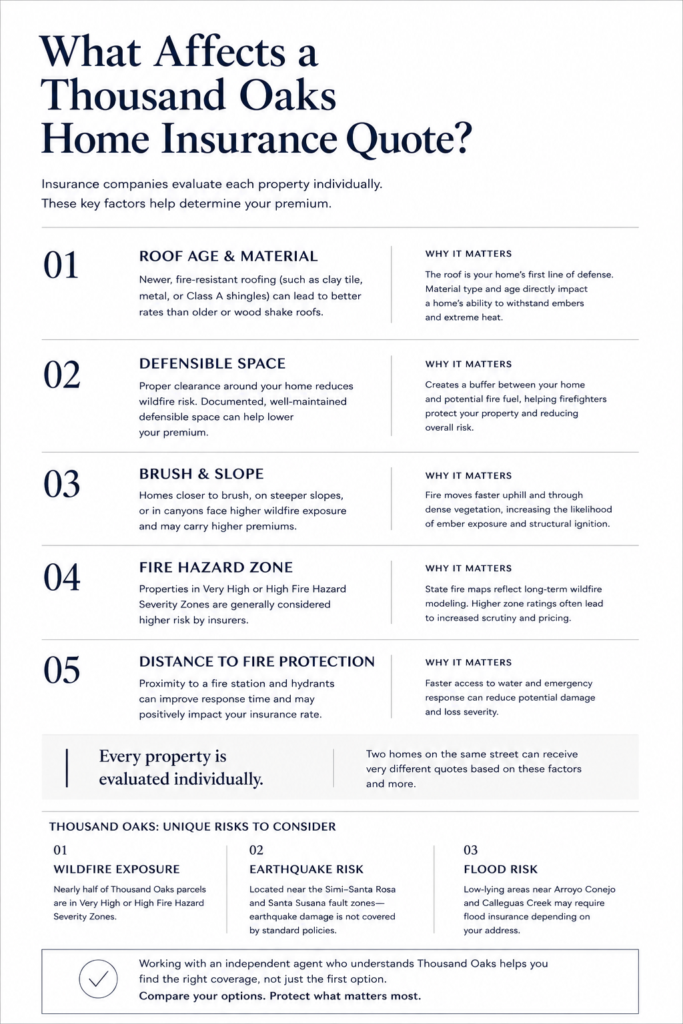
Underwriters weigh a handful of property-specific factors before quoting a premium: the home’s age and roof type, how much local rebuilding costs have risen since the policy was last priced, and whether a documented defensible space assessment is on file.
Given how far rebuilding costs have climbed since the Woolsey Fire, it’s worth asking a carrier about an extended or guaranteed replacement cost endorsement, which pays a set percentage above the base dwelling limit rather than leaving a homeowner to cover a shortfall if the full rebuild costs more than expected.
Wildfire Risk Across the Conejo Valley
How Much of Thousand Oaks Sits in a High Fire Hazard Zone
Close to half of the parcels in Thousand Oaks fall within a Very High or High Fire Hazard Severity Zone under the state’s updated maps, according to Zone 0 Conejo Valley, a resident group formed around the recent zone expansion. Ventura County Fire Protection District adopted the new boundaries in mid-2025, expanding the mapped hazard area by more than 100% compared to the 2010 maps countywide.
What the Woolsey Fire Showed About Local Risk
The 2018 fire proved that a wind-driven wildfire could threaten neighborhoods well inside city limits, not just the canyon-adjacent homes typically assumed to carry the highest risk. That history is part of why underwriters now look at brush proximity and slope parcel by parcel rather than pricing “Thousand Oaks” as a single risk category.
What a High Fire Hazard Rating Changes About a Quote
A Very High or High designation doesn’t automatically mean a carrier declines a property, but it usually means the underwriter asks for more before quoting: roof material and age, the type and width of defensible space around the structure, and how close the nearest fire hydrant or station sits. Two homes a few blocks apart can land in different rate tiers once those specifics come into play, which is why a quote based only on a Thousand Oaks address rarely tells the full story.
Earthquake Risk From Regional Fault Systems
Thousand Oaks sits near the Simi-Santa Rosa and Santa Susana fault zones, part of the same reverse-fault system responsible for the 1994 Northridge earthquake, according to research published by the Southern California Earthquake Center. That magnitude 6.7 quake caused at least 57 deaths and roughly $20 billion in direct damage, per the California Geological Survey.
Thousand Oaks absorbed real damage that morning. The city’s library alone sustained $2.5 million in losses when a ceiling collapse and sprinkler failure destroyed part of its children’s book collection, forcing an 18-month relocation, according to a 25th-anniversary retrospective from The Acorn. Standard homeowners policies exclude this kind of shaking damage entirely, which is why earthquake coverage in this part of Ventura County has to be bought as its own policy.
Flood Risk Near Arroyo Conejo
Arroyo Conejo, the city’s primary drainage, feeds into the larger Calleguas Creek watershed system, according to the Ventura County Public Works Agency. Most of Thousand Oaks sits outside mapped high-risk flood zones, though low-lying pockets near Newbury Park warrant an address-specific FEMA flood zone check before assuming no coverage is needed.
Old Harbor’s claims resource on property coverage walks through how a claim moves once a policy responds, which matters here since earthquake, flood, and standard fire claims each follow a different track with a different carrier.
How Old Harbor Insurance Helps Thousand Oaks Homeowners
Old Harbor represents 81 A-rated carriers rather than a single company, so a Thousand Oaks homeowner isn’t limited to whatever one insurer decides about the Conejo Valley. That range matters most for properties in a Very High fire zone, where availability shifts from one carrier to the next depending on how much wildfire exposure each company is currently willing to take on.
The agency also reviews each property’s specific fire zone, fault proximity, and flood risk before recommending a carrier, rather than defaulting to the FAIR Plan just because a home sits in Thousand Oaks. Standard-market coverage is often still available even on streets where a neighbor assumed it wasn’t.
Compare Thousand Oaks Coverage Options Before You Renew
A policy quoted five years ago may not reflect what a Thousand Oaks property faces today, especially after the fire map changes and non-renewal activity of the past two years. Old Harbor checks a home’s fire zone, fault exposure, and flood risk against carriers currently active in the area before recommending a policy.
Reach out through Contact Us to go over your renewal, or start with a Get a Quote request to see what’s currently available.
Frequently Asked Questions
Do homes rebuilt after the Woolsey Fire get better insurance rates than neighboring homes that weren’t rebuilt?
Often yes, since a home rebuilt after 2018 typically meets current fire and building codes, including ignition-resistant materials that didn’t exist when the original structure went up. Two similar homes on the same street can end up with different rates once a carrier factors in that construction gap.
Is earthquake insurance required to get a mortgage in Thousand Oaks?
No, lenders don’t require earthquake coverage the way they require standard hazard insurance, since it’s treated as optional coverage under most loan agreements. Some lenders ask homeowners to sign an acknowledgment that earthquake damage isn’t included in the base policy.
Does Thousand Oaks’s new ember-resistant landscaping requirement affect insurance premiums?
It can, since documented compliance with defensible space and ember-resistant landscaping rules is one of the mitigation measures carriers must consider for wildfire discounts. Keeping dated photos of completed work helps, since carriers typically ask for proof during underwriting.
Does sitting in a FEMA flood zone raise home insurance costs even without a flood claim history?
Yes, carriers price flood risk based on zone designation and elevation rather than an individual homeowner’s claims record. A lender may also require flood insurance as a condition of the mortgage if the home sits in a high-risk zone, regardless of past claims.
Can a Thousand Oaks homeowner keep their current carrier if they’ve never filed a claim?
Not always. A clean claims history doesn’t guarantee renewal if a carrier is reducing its overall exposure in a wildfire-prone region, since some companies non-renew profitable, claim-free accounts simply to shrink their footprint in an area. That’s part of why some longtime Thousand Oaks homeowners have received non-renewal letters despite years without a claim.
What’s the fastest way for a Thousand Oaks homeowner to lower a premium without dropping coverage?
Raising the deductible is usually the quickest change, since moving from a $1,000 to a $2,500 deductible often produces a noticeable discount on its own. Bundling home and auto with the same carrier and asking about credits for completed mitigation work can add further savings without touching the coverage itself.
What happens if a Thousand Oaks home’s value exceeds a carrier’s standard coverage limit?
Standard carriers cap dwelling coverage well below the value of some higher-end Thousand Oaks homes, and the FAIR Plan carries its own per-policy limit as well, so these properties sometimes need an excess or umbrella-style policy layered on top. An independent agent can identify which carriers offer higher dwelling limits before assuming standard coverage falls short.