

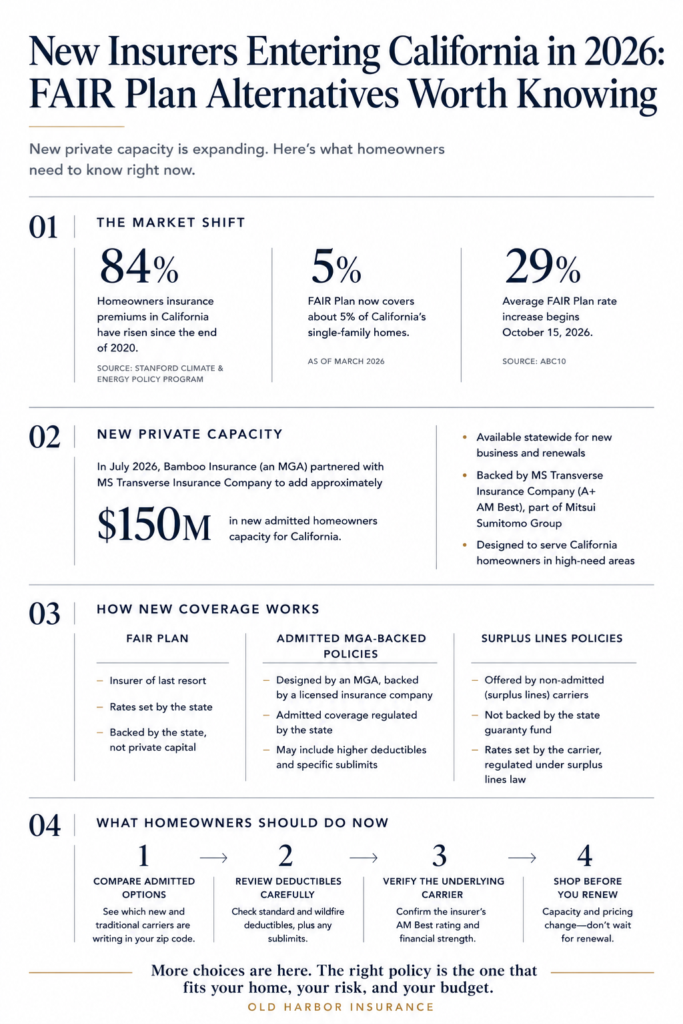
California homeowners insurance premiums rose 84 percent between the end of 2020 and March 2026, according to Stanford’s Climate and Energy Policy Program, and more than one in 17 new home loans in the state now carries FAIR Plan coverage as the only option available. The FAIR Plan itself is raising rates by an average of 29 percent starting October 15, 2026, according to ABC10.
Against that backdrop, new admitted capacity is starting to show up outside the usual list of national carriers. Old Harbor Insurance is tracking which of these newer options are writing policies right now, not just announcing plans to.
The FAIR Plan Keeps Growing, Even as It Gets Pricier
The FAIR Plan covered about 5 percent of California’s single-family homes as of March 2026, up from 1.5 percent in December 2020, but it backed roughly 6 percent of new single-family mortgage originations statewide. Average deductibles on FAIR Plan and comparable policies climbed from $1,813 to $2,553 over the same stretch, and seven of the state’s 12 largest home insurers had reduced or halted new underwriting by 2022.
That combination, rising cost paired with rising reliance, is what Stanford researchers flagged as the more troubling trend: the FAIR Plan is no longer a wildfire-zone problem alone. It is showing up in moderate-risk zip codes at twice its overall market share, which the researchers called a leading indicator of deeper trouble ahead for the broader housing market, not just the insurance market.
A New Kind of Capacity Is Entering the Market
The clearest example is a July 2026 partnership between Bamboo Insurance, a managing general agent, and MS Transverse Insurance Company, which added roughly $150 million in admitted homeowners and dwelling fire capacity aimed at Los Angeles, San Diego, and San Francisco. The capacity became available statewide for new business and renewals that month, according to Insurance Business.
This is a different kind of entrant than the legacy carriers writing more distressed-area policies under the state’s catastrophe-modeling reforms. Bamboo is a managing general agent, meaning it designs and distributes the policy but places the risk itself with a licensed insurance company, in this case MS Transverse, which holds an A+ AM Best rating and is backed by Mitsui Sumitomo.
Why MGAs Are Filling This Gap
That fronting-carrier structure, an MGA designing the policy while a separately rated insurer stands behind the risk, is how a growing share of new capacity is reaching California homeowners. Managing general agent and delegated-authority premium nationally grew nearly 15 percent in both 2023 and 2024, reaching close to $90 billion.
These arrangements let capital move into hard-to-place markets faster than a traditional insurer can build out a state license and rate filing from scratch. For a homeowner comparing options, the practical takeaway is that the carrier standing behind the policy matters more than which name is on the marketing.
What These Newer Policies Look Like
Bamboo’s California homeowners product includes deductible tiers running as high as $10,000, a mandatory water damage sublimit, and a claim-free discount that grows the longer a policyholder goes without filing. Higher deductibles are a common trade-off across this newer wave of capacity, not a Bamboo-specific quirk, and they are worth comparing against a FAIR Plan premium before assuming a new admitted option is automatically cheaper.
Homeowners considering one of these newer policies should ask what the deductible looks like specifically for wildfire claims, since some products separate that figure from the standard deductible entirely.
Admitted Capacity Versus a Surplus Lines Policy
Not every option from a newer MGA is admitted coverage. Bamboo also sells surplus lines policies through non-admitted carriers for homes that still don’t fit an admitted program, and that distinction matters. Surplus lines policies aren’t backed by the state guaranty fund if the carrier fails, though they remain subject to surplus lines law and solvency requirements.
For most homeowners, an admitted policy is worth pursuing first, and a surplus lines option becomes reasonable only after checking that the underlying carrier carries a strong AM Best rating.
Is Any of This Displacing the FAIR Plan?
FAIR Plan residential policy growth slowed to about 2.4 percent in the first quarter of 2026, down sharply from the 35,000 to 50,000 new policies it had been adding per quarter through 2024 and 2025. That is the clearest available sign that admitted capacity, including partnerships like Bamboo’s, is starting to pull demand away from the state’s insurer of last resort rather than simply adding to the same pressure.
Mercury alone has pledged more than 38,000 new policies over time as part of its own commitment to write in wildfire-distressed areas. Whether that pace holds depends on how much reinsurance and third-party capital keeps flowing into these newer fronting arrangements, which is a separate variable from the state’s own regulatory timeline.
Where This Still Falls Short
A slower growth rate is not the same as a shrinking FAIR Plan. Even at 2.4 percent quarterly growth, the FAIR Plan is still adding policies, just at a fraction of its 2024 and 2025 pace, and it remains the only option in the highest-risk zip codes these newer partnerships tend to avoid.
The capital behind arrangements like Bamboo’s is also tied to reinsurance pricing, which is currently softening but has swung the other direction before. A homeowner who qualifies for one of these newer policies today should not assume the same capacity will be there at every future renewal.
How Old Harbor Insurance Helps
Old Harbor works with 81 A-rated carriers, and that list now includes newer fronting arrangements alongside the traditional names, which means a homeowner does not have to track down and vet each new MGA individually. Agents compare what a specific newer option covers, including deductible structure, wildfire-specific sublimits, and how a claim gets handled, against both a FAIR Plan policy and a legacy carrier’s offer.
For a homeowner who was non-renewed and placed on the FAIR Plan in the last two years, that comparison is worth revisiting now rather than waiting for the next renewal cycle, since capacity in this market has changed meaningfully in just the past several months.
Get a Comparison Before You Renew
Homeowners currently on the FAIR Plan, or facing the October rate increase, can contact Old Harbor to see which admitted carriers and newer capacity partnerships are writing in their zip code right now. Get a quote to compare a specific newer option against what the FAIR Plan currently charges.
Frequently Asked Questions
Is a managing general agent the same thing as an insurance company?
No, a managing general agent designs and distributes a policy under authority delegated by a licensed insurer, but it is that insurer, not the MGA, that holds the financial responsibility for paying claims. Checking the underlying carrier’s financial strength rating matters more than the MGA’s name.
Does a higher deductible on a newer policy always mean a lower premium?
Not necessarily, since pricing also depends on the specific wildfire risk model and reinsurance costs behind that carrier. Comparing the full premium and deductible together, rather than either figure alone, is the only way to know which policy costs less overall.
Can a homeowner leave the FAIR Plan mid-term to switch to a new admitted carrier?
Yes, a FAIR Plan policy can be canceled once a new policy is bound, and most carriers prorate the FAIR Plan refund for the unused portion of the term. There is no penalty for leaving before the FAIR Plan’s renewal date.
Are claim-free discounts on newer policies transferable if a home is sold?
No, a claim-free discount is tied to the policyholder’s history with that carrier, not the property, so a buyer starts without it even if the home itself was never the subject of a claim.
Why did seven of California’s largest insurers reduce underwriting even before the current reforms?
Proposition 103, passed in 1988 to manage auto insurance costs, also restricted how much home insurers could price policies based on projected future risk rather than historical losses. That restriction, layered onto escalating wildfire losses, is what pushed many large carriers to pull back starting around 2022, years before the current wave of new capacity began arriving.
Does the FAIR Plan’s October 2026 rate increase apply to policies already in force?
It applies at each policy’s next renewal after October 15, 2026, not immediately to every policyholder on that date. A policy renewing in November will see the new rate; one that just renewed in September will not see it until the following year.
Is surplus lines coverage regulated by the California Department of Insurance the same way admitted coverage is?
No, surplus lines carriers set their own rates without prior approval from the department, though the brokers who place that coverage must still be licensed in California. That is one reason admitted options, including newer MGA-fronted policies, are generally worth comparing first.