

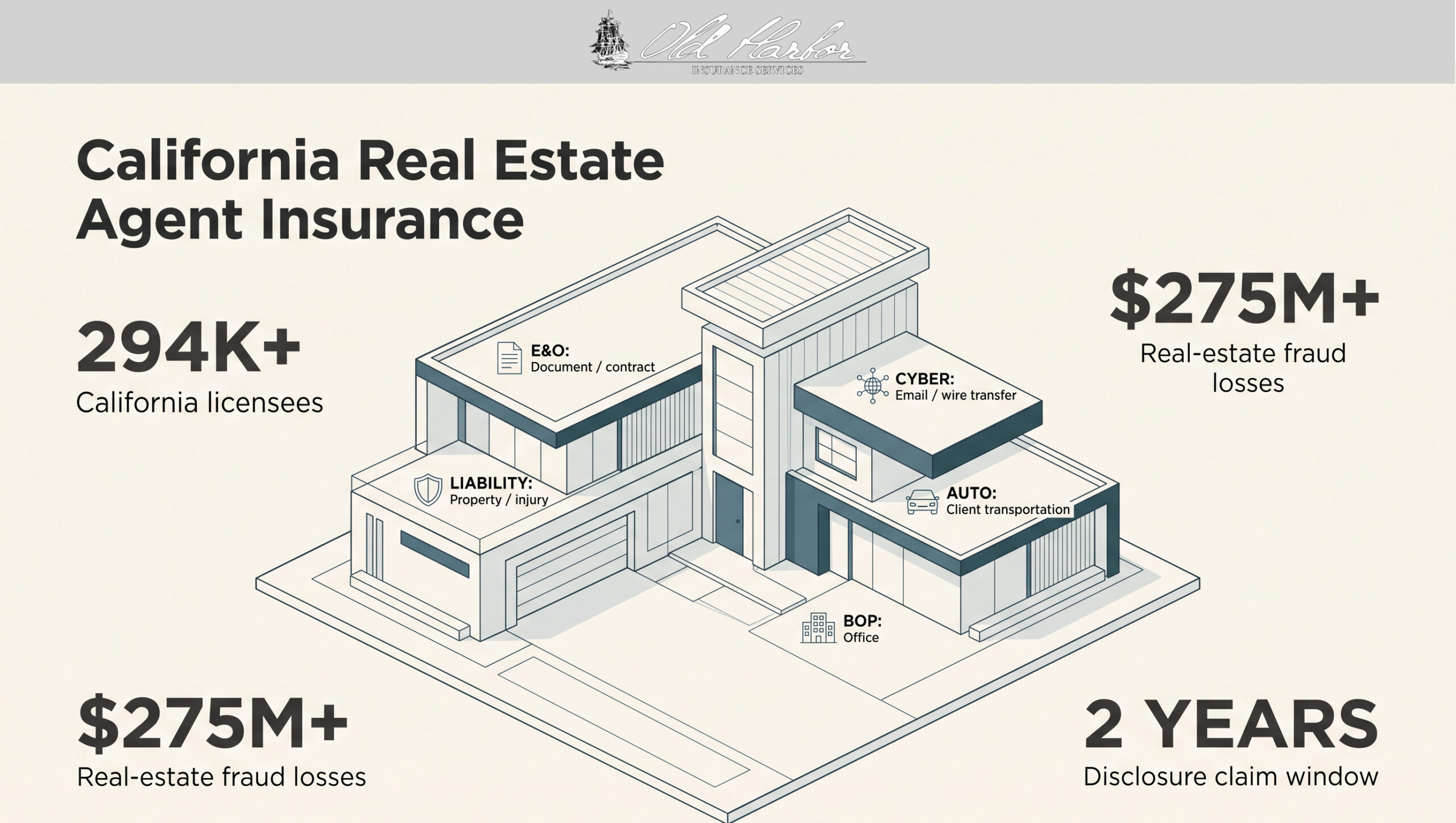
More than 294,000 real estate licensees were active in California as of last spring, according to a firsttuesday Journal analysis of state licensing data, and nearly all of them work as independent contractors rather than brokerage employees, filing their own 1099s and carrying much of their own liability.
Old Harbor Insurance builds real estate agent insurance in California around that arrangement, since a policy that only protects the brokerage rarely protects the agent standing in front of a client at an open house.
An agent leaning entirely on a brokerage’s blanket E&O policy might find out too late that the coverage carries a shared limit, a steep deductible, or doesn’t follow them to the next brokerage.
That shared limit is split across every agent at the firm, so two or three claims filed the same year can use up what’s left for everyone else. Reading the actual policy terms, instead of assuming they apply the same way to every agent, is where most of these surprises get caught.
What Real Estate Agent Insurance Covers in California
Most agents and brokers need three types of coverage a personal auto or homeowners policy doesn’t touch: errors and omissions for mistakes made while representing a client, general liability for injuries or property damage tied to the job, and increasingly, cyber coverage for the wire fraud schemes targeting real estate closings.
| Coverage Type | What It Addresses |
| Errors and omissions (E&O) | Negligence, misrepresentation, or failure to disclose tied to a transaction |
| General liability | Injuries or property damage at showings, open houses, or the office |
| Cyber and wire fraud | Funds diverted through spoofed emails or fraudulent wiring instructions |
| Commercial or hired/non-owned auto | Accidents while driving clients to showings in a personal vehicle |
| Business owner’s policy | Property and liability coverage bundled for a small brokerage office |
Errors and Omissions Coverage
Errors and omissions insurance pays legal costs and settlements when a client claims an agent’s negligence, misrepresentation, or failure to disclose cost them money on a deal. It excludes intentional misconduct or fraud outright, since E&O is built to cover honest mistakes, not deliberate ones. Coverage is usually written on a claims-made basis, so the policy active when a claim is filed matters more than the one active when the deal closes.
General Liability for Real Estate Professionals
General liability steps in when someone other than a client gets hurt, or a property gets damaged, because of the job rather than the transaction itself. A visitor who trips on a loose step during an open house, or a lockbox that scratches a client’s door, falls under this coverage instead of E&O. Brokerages leasing office space typically need to carry it as a condition of the lease.
Cyber and Wire Fraud Coverage
Cybercriminals stole more than $275 million from real estate transactions in 2025, the National Association of REALTORS reported, citing FBI data, much of it through spoofed emails that trick buyers into wiring closing funds to the wrong account. Standard E&O and general liability policies weren’t built for this kind of fraud, and many exclude it outright unless a cyber or social engineering endorsement is added.
Why California Real Estate Agents Face Distinct Insurance Risks
California’s Disclosure Laws Raise the Liability Bar
California requires sellers to complete a Transfer Disclosure Statement covering everything from structural defects to unpermitted additions, a requirement that can’t be waived even in an as-is sale under Civil Code Section 1102.
Listing agents carry their own duty here too, since they’re expected to conduct a reasonably competent visual inspection of the property and report anything affecting value. Buyers who later find something the disclosure missed generally have two years from close of escrow to bring a claim.
E&O Isn’t State-Mandated, But It’s Rarely Optional
California doesn’t require real estate licensees to carry E&O insurance as a condition of holding a license, unlike several other states. Almost every brokerage requires it anyway, either through its own blanket policy or by requiring each agent to carry an individual one. Some brokerages also pass the shared policy’s deductible straight to whichever agent gets named in a claim, which can run into five figures.
How Much Does Real Estate Agent Insurance Cost in California?
Premiums depend on transaction volume, the coverage limit and deductible chosen, and whether the policy is written for an individual agent or an entire brokerage. An agent closing five transactions a year carries different exposure than a top producer closing fifty, even selling similar homes.
Claims history matters too, along with whether the agent also flips houses, manages rental property, or otherwise wears more than one hat in a transaction. The most common types of claims against agents involve disclosure disputes, according to CRES Insurance, followed by water-intrusion and permit issues that surface well after closing.
How Old Harbor Insurance Helps
Real estate agents often already have a homeowners or auto policy with Old Harbor Insurance, so adding E&O, general liability, and cyber coverage usually means one more call instead of a whole new relationship.
Working with more than 80 A-rated carriers means coverage gets built around an agent’s real transaction volume, not squeezed into a one-size policy meant for a much bigger or smaller operation.
Agents also get help figuring out where a brokerage’s coverage stops, whether that’s a shared aggregate limit, a hole in coverage after leaving the firm, or a dispute over what the policy was supposed to cover once a claim is filed. An agent who brings in a copy of the brokerage’s policy usually walks out knowing exactly what still needs filling in.
Get Your Real Estate Business Properly Covered
A brokerage’s blanket policy might be enough for some agents and fall well short for a top producer closing dozens of deals a year.
Contact Old Harbor Insurance to see where personal coverage picks up where the brokerage leaves off, or get a quote to compare E&O and liability options built around real transaction volume.
Frequently Asked Questions
Does E&O insurance cover claims filed years after a transaction closes?
An agent who lets a policy lapse after retiring or switching brokerages can lose coverage for deals closed years earlier, even if nothing was wrong with the work at the time. Extended reporting coverage, sometimes called tail coverage, keeps old transactions covered after the original policy ends. That protection matters in California, where buyers generally have up to two years from closing to bring a disclosure claim.
Does general liability cover an agent’s car while driving clients to showings?
General liability insurance typically excludes vehicle accidents, even when the agent is driving a client to a showing as part of the job. A personal auto policy may also deny a claim if it treats that driving as business use rather than personal use. Agents who regularly drive clients need a commercial or hired and non-owned auto policy to cover that exposure.
Can a broker be held liable for a claim caused by one of their agents?
Brokers can be named in a claim alongside their agents under a legal theory called vicarious liability, since agents typically operate under the broker’s license and supervision. That exposure is part of why many brokerages require every agent to carry individual E&O coverage rather than relying on one shared policy. A broker’s own coverage limits can come under pressure when several agents at the same firm are named in the same lawsuit.
Does E&O insurance cover intentional misrepresentation or fraud by an agent?
A carrier can deny an E&O claim outright, and stop covering an agent’s legal defense, once it determines a defect was knowingly hidden rather than missed. Insurers investigate that distinction rather than take an accusation of fraud at face value, since the outcome turns on what the agent knew at the time, not just what the buyer later discovered.
An agent who already received a defense-cost advance on a claim later ruled intentional can be asked to pay that money back.
Do agents who also flip or invest in property need different coverage than agents who only list homes?
Agents who buy, renovate, and resell property are acting as principals in those deals, not just as licensed representatives, and a standard E&O policy doesn’t always cover that role. Playing both roles on the same transaction, representing a buyer while also holding an ownership stake, is one of the harder situations for a standard policy to untangle. A separate landlord or builder’s risk policy usually needs to sit alongside the E&O coverage for the flip or the rental.
Does cyber or wire fraud coverage protect an agent if the client’s own email gets hacked?
Wire fraud coverage is built around where the fraud originates, and a policy written for the agent’s business doesn’t automatically extend to a breach that happened on the client’s or another party’s email account.
Some cyber endorsements do cover an agent’s liability for failing to warn a client about wiring risks, even when the hack happened elsewhere. What triggers a payout often has nothing to do with what the endorsement’s name promises, so the exclusions matter more than the label.
What happens to an agent’s E&O coverage when they switch brokerages mid-year?
An agent’s E&O coverage generally stays with whoever issued the policy, not the brokerage, when it’s purchased individually rather than through the firm’s blanket plan. Coverage tied to a brokerage’s blanket policy typically ends the day the agent leaves, no matter when the policy term was set to renew. A transaction closed under the old brokerage can end up with no policy willing to respond to it if that gap isn’t caught during the move.