
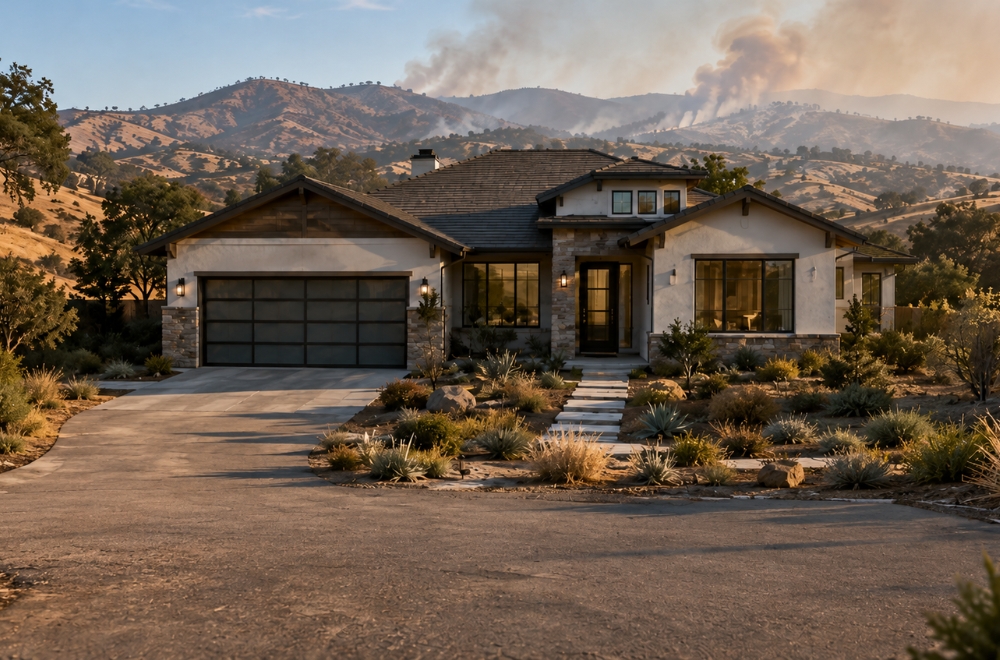
California homeowners who can’t access the standard insurance market face a real choice: the California FAIR Plan or newer private alternatives like Orion180’s FLEX Home Insurance. These two options exist in different market tiers, serve different needs, and carry meaningfully different coverage structures. Understanding those differences beyond premium price determines whether a homeowner is genuinely protected or simply covered on paper.
Old Harbor Insurance places both FAIR Plan policies and Orion180 FLEX coverage for California homeowners, and works across 81 A-rated carriers to find the right structure for each property. This article compares both options objectively so homeowners can make an informed decision.
What Does California’s FAIR Plan Entail?
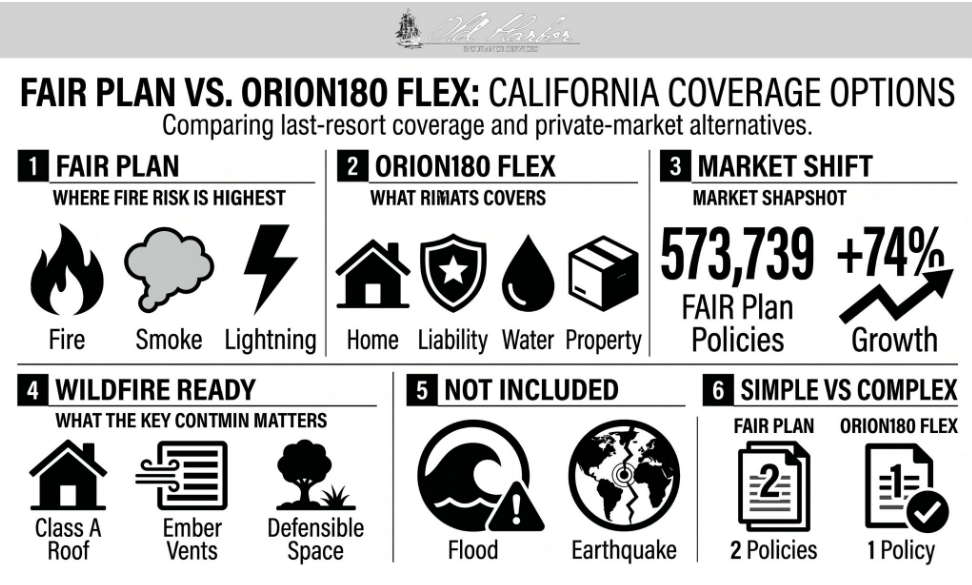
The California FAIR Plan was created as a temporary safety net, the insurer of last resort for homeowners who cannot obtain coverage in the voluntary private market. It was never intended to function as a comprehensive homeowners policy. Its standard coverage includes fire, smoke, lightning, and internal explosion. Extended coverage endorsements can add wind, hail, and a limited set of additional perils.
What it does not include is equally important. The FAIR Plan excludes liability protection, theft coverage, water damage, and additional living expenses as standard components. According to FAIR Plan key statistics data, enrollment reached 573,739 policies as of early 2025 — up 74% since September 2023. Following the January 2025 LA fires, the FAIR Plan faced $4.1 billion in total losses, paid $1.2 billion in claims, and levied a $500 million assessment on private insurers — costs that flow back to California policyholders statewide.
What Orion180 FLEX Home Insurance Is
Orion180 launched FLEX Home Insurance in California on September 16, 2025, through Orion180 Insurance Co., its surplus lines entity. FLEX functions as a full homeowners policy — covering dwelling, other structures, personal property, liability, and additional living expenses in a single policy without requiring a paired DIC policy.
Coverage Limits and Financial Strength
According to Orion180’s California launch announcement, FLEX provides dwelling coverage from $400,000 to $3 million, with total insured values reaching $5 million. Orion180 received an A rating affirmation from Demotech in December 2025 and expanded its reinsurance capacity by 36% for 2026, backed by 41 reinsurers.
Side-by-Side Coverage Comparison
| Feature | California FAIR Plan | Orion180 FLEX |
| Policy type | Last-resort insurer | Surplus lines private insurer |
| Dwelling coverage | Up to $3M | $400K–$3M (total up to $5M) |
| Liability protection | Not included | Included |
| Personal property | Limited | Included |
| Additional living expenses | Not included | Included |
| Water damage | Not included | Included |
| Theft | Not included | Included |
| Wildfire coverage | Yes (fire/smoke) | Yes (comprehensive perils) |
| DIC policy required | Yes, to fill gaps | No |
| CIGA insolvency protection | Yes | No (surplus lines) |
| Availability | Any property denied standard coverage | Higher-risk properties statewide |
The table makes one thing clear: the FAIR Plan requires a supplemental Difference in Conditions policy to approximate the coverage breadth that Orion180 FLEX provides in a single policy. Understanding how claims are handled under each structure is essential — the claims process differs significantly between the two.
The DIC Policy Cost Consideration
Most FAIR Plan policyholders pair it with a DIC policy to fill the liability, water damage, and personal property gaps. Those supplemental DIC policies typically add $800–$2,000 annually to insurance costs, creating a two-policy structure that requires coordination and introduces the possibility of coverage gaps at the seams where the two policies interact.
Orion180 FLEX eliminates that coordination requirement. A single policy covering all standard homeowners perils simplifies both ongoing management and the claims process after a loss. The total cost comparison between a FAIR Plan plus DIC combination and an Orion180 FLEX policy depends on the specific property, but the administrative simplicity and breadth of single-policy coverage is a meaningful practical advantage.
How Each Assesses Wildfire Risk
The CAL FIRE Office of the State Fire Marshal produces FHSZ maps based on broad hazard factors — vegetation, terrain, and fire weather — without accounting for individual mitigation. The FAIR Plan uses these zone designations as a primary eligibility indicator.
Orion180’s proprietary risk scoring evaluates each property at the address level, incorporating construction materials, defensible space, roof type, and proximity to open space — which can produce more favorable outcomes for well-hardened homes in High or Very High zones.
How Wildfire Mitigation Affects Both Options
California’s Safer from Wildfires framework requires admitted insurers to offer premium discounts for documented wildfire mitigation. While Orion180 operates as a surplus lines carrier and is not subject to the same regulatory mandate, its property-level risk scoring means documented mitigation directly affects pricing. For FAIR Plan policyholders, mitigation documentation builds the case for transitioning back to the voluntary market when it becomes available.
The most impactful steps for California homeowners considering either option:
- Installing a Class A fire-resistant roof
- Replacing combustible wood vents with ember-resistant alternatives
- Maintaining 100 feet of documented defensible space
- Replacing combustible siding with fire-resistant materials
The Insurance Institute for Business and Home Safety has documented that ember intrusion through vents and roof vulnerabilities are the two primary wildfire ignition pathways for residential structures. These are individual property characteristics that Orion180’s property-level risk model can recognize and reward — while a FHSZ map-based assessment cannot. Visible mitigation improvements also register in the aerial and satellite imagery that carriers use during underwriting review, making official documentation through a fire district inspection the most reliable way to ensure those improvements affect your outcome.
How to Document Improvements Effectively
- Get a formal inspection: Request a defensible space inspection through your county fire district to create an official compliance record that all insurers recognize.
- Keep clear records: Take date-stamped photos of all structural improvements and save contractor receipts for roof, vent, and siding upgrades.
- Align with the state framework: Use the California Department of Insurance’s Safer from Wildfires criteria. Documentation tied to these standards carries the most weight during underwriting reviews.
What the FAIR Plan + DIC Combination Actually Costs
- The true cost: The FAIR Plan base rate is only half the story. A supplemental Difference in Conditions (DIC) policy adds $800–$2,000 annually to cover gaps like liability, water damage, and theft.
- The hidden complexity: Managing two separate policies means dealing with two deductibles, separate claims processes, and potential coverage gaps at the boundaries.
- The single-policy alternative: Orion180 FLEX replaces this entire two-policy setup with a single, unified policy. When budgeting, always compare the total cost of a FAIR Plan + DIC premium against a standalone option.
Next Step: Have an independent agent run a side-by-side comparison with real numbers for your specific property.
Flood and Earthquake: Gaps Neither Option Fills
Neither the FAIR Plan nor Orion180 FLEX includes flood or earthquake coverage as standard components. According to FEMA, flood damage requires a separate policy through the National Flood Insurance Program or a private flood carrier regardless of which primary homeowners product you carry.
Earthquake coverage similarly requires a separate policy — typically through the California Earthquake Authority — and is excluded from both FAIR Plan and Orion180 FLEX as standard. For California homeowners in seismically active areas or near flood-prone terrain, building a complete coverage picture means addressing these gaps alongside the primary policy comparison.
Navigating the Shifting California Market
California’s Sustainable Insurance Strategy reforms are creating real incentives for admitted carriers to return to higher-risk markets. For homeowners on the FAIR Plan or using Orion180, the path back runs through documented mitigation improvements and annual re-shopping with an independent agent who can identify which admitted carriers are currently writing in their ZIP code.
How Old Harbor Structures the Right Option for Your Property
Orion180 FLEX and the FAIR Plan are both available through licensed insurance agents — neither accepts direct applications from homeowners. Old Harbor Insurance places both products, which means the comparison you get is genuine rather than limited to whichever product a single carrier offers. We also have a detailed breakdown of Orion180 FLEX on our blog for homeowners who want to go deeper on the product specifics before requesting a quote.
Contact us to discuss which structure makes the most sense for your property. Get a quote to see real pricing across both options.
Frequently Asked Questions
Does the FAIR Plan provide full homeowners insurance coverage?
No. The FAIR Plan covers fire, smoke, lightning, and internal explosion as standard perils. It does not include liability protection, theft, water damage, or additional living expenses without a supplemental Difference in Conditions policy. Most FAIR Plan policyholders carry both, which adds $800–$2,000 annually and creates a two-policy coordination requirement.
Is Orion180 an admitted carrier in California?
No. Orion180 operates in California through Orion180 Insurance Co., its surplus lines entity. Surplus lines carriers are not backed by the California Insurance Guarantee Association, which provides insolvency protection for admitted carrier policyholders. Orion180 holds an A rating from Demotech (affirmed December 2025), which reflects financial stability and claims-paying ability.
What is a Difference in Conditions (DIC) policy?
A DIC policy is a supplemental policy paired with a FAIR Plan policy to fill its coverage gaps — liability, water damage, theft, and additional living expenses. Without it, a FAIR Plan policyholder has no liability protection if someone is injured on their property and no coverage for temporary housing after a fire. Orion180 FLEX includes all of these components in a single policy, eliminating the need for a DIC.
Can I switch from FAIR Plan or Orion180 to a standard admitted carrier later?
Yes. Both are designed as alternatives when the standard market isn’t available, not permanent placements. Returning to admitted coverage requires documented wildfire mitigation improvements, favorable property-level risk scoring from the carrier, and a market where the carrier is actively writing in your ZIP code. Annual re-shopping with an independent agent is the most reliable way to identify when that window opens.
How do wildfire mitigation improvements affect my options?
Documented improvements — Class A roofing, ember-resistant vents, defensible space — affect both pricing and eligibility. For FAIR Plan policyholders, they support the case for transitioning to private market coverage. For Orion180 FLEX, they feed directly into the proprietary property-level risk score and can reduce premium. For admitted market re-entry, they satisfy the Safer from Wildfires discount requirements and improve underwriting eligibility.
What California insurance reforms are affecting the market?
California’s Sustainable Insurance Strategy allows admitted insurance companies to use forward-looking wildfire models and factor reinsurance costs into their rates. In exchange, these companies must write a higher volume of policies in high-risk areas, giving homeowners on the FAIR Plan a gradual path back to traditional coverage.
How does Orion180’s wildfire risk scoring differ from FHSZ zone maps?
Official FHSZ maps assess hazard at a broad geographic level based on terrain and vegetation, completely ignoring individual property improvements. In contrast, Orion180’s model scores risk at the specific address level, actively factoring in your home’s mitigation like roof type, upgraded vents, and defensible space. This means a well-hardened home can earn a much better risk score than standard zone maps suggest.