
Allstate stopped writing new homeowners policies in California in 2022 and confirmed the pause publicly in mid-2023, according to Insurance Business Magazine.
Existing policyholders haven’t been fully shielded either: the consumer nonprofit United Policyholders has documented Allstate non-renewal letters telling longtime customers the decision “is not intended to reflect negatively on your insurability,” a line that explains nothing about why the policy ended.
Old Harbor Insurance helps California homeowners who’ve received one of these letters compare replacement coverage from carriers still writing new business. A cancellation or non-renewal letter from Allstate isn’t the end of the search for coverage, but it does start a clock.
California law gives homeowners a specific, limited window to find a new policy, and knowing exactly what that letter is allowed to say, and when it has to arrive, changes how much time is left to work with.
Why Allstate Has Pulled Back on California Homeowners Coverage
Allstate’s own explanation, given to reporters when the pause became public, was straightforward: wildfire losses, rebuilding costs, and reinsurance prices had pushed the cost of covering new California homes above what regulators would let Allstate charge for it.
Allstate has also pursued large rate increases on its existing book, filing for a 34.1% homeowners rate hike in 2024 that affected more than 350,000 policyholders statewide, according to Insurance Journal.
The California Department of Insurance has since asked Allstate and several other large carriers to write more coverage in wildfire-distressed areas in exchange for using updated catastrophe models in rate filings, a tradeoff NBC Bay Area detailed in its 2024 coverage of the state’s insurance overhaul. Allstate hasn’t said publicly when, or whether, it will resume writing new California homeowners business at scale.
Cancellation vs. Non-Renewal: They Aren’t the Same Letter
California law makes a clear distinction between a cancellation and a non-renewal. That difference is important because it dictates exactly how much notice your insurer is required to give you.
When Allstate Can Cancel a Policy Mid-Term
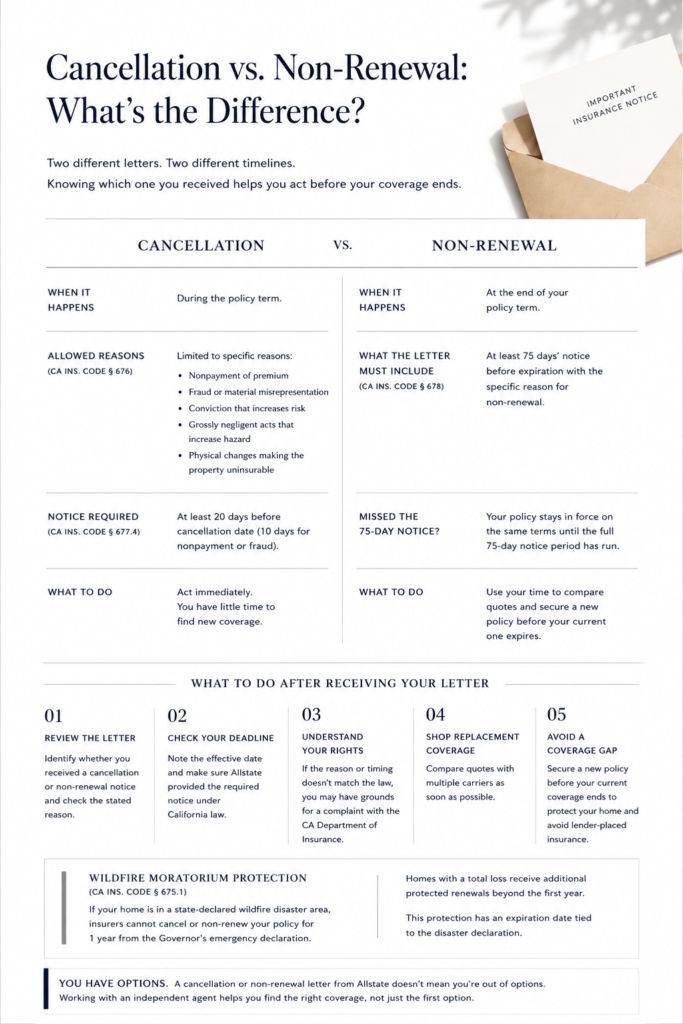
Once a homeowners policy has been active more than 60 days, California Insurance Code Section 676 limits mid-term cancellation to a short list of reasons: nonpayment of premium, fraud or material misrepresentation, a conviction that increases the insured risk, grossly negligent acts that increase the hazard, or physical changes that make the property uninsurable. Wildfire risk alone isn’t one of them.
Notice of a mid-term cancellation must go out at least 20 calendar days before it takes effect, or 10 days if the reason is nonpayment or fraud, under Section 677.4. That short runway is why a genuine cancellation notice deserves an immediate call to an agent rather than a wait-and-see approach.
What a Non-Renewal Notice Has to Include
A non-renewal is different: Allstate simply declines to offer another term when the current policy expires, and insurers have much more room to make that call. California Insurance Code Section 678 requires that notice at least 75 days before expiration, stating the specific reason rather than a vague reference to “business decisions.”
If Allstate misses that 75-day window, the existing policy stays in force on its current terms until the full notice period has run.
Wildfire Moratorium Protection Can Delay a Non-Renewal
Homes inside or adjacent to a state-declared wildfire disaster area get extra protection under California Insurance Code Section 675.1, enacted through SB 824 in 2018. For one year after the Governor’s emergency declaration, insurers can’t cancel or non-renew residential policies in the affected ZIP codes, and homes with a total loss get added protected renewals beyond that first year.
This moratorium doesn’t stop Allstate from declining new business statewide, and it expires on a fixed date tied to the disaster declaration, not the homeowner’s renewal date. A policy protected by the moratorium today can still receive a valid non-renewal notice the moment that one-year window closes.
What to Do After an Allstate Cancellation or Non-Renewal Letter
Read the stated reason first. If the letter cites a § 676 ground that doesn’t match the actual property or account history, or if it arrived without the required lead time, that’s grounds for a complaint through the California Department of Insurance’s consumer hotline.
If the reason is a straightforward non-renewal, the more useful move is getting replacement quotes started immediately rather than disputing a decision insurers are broadly allowed to make.
Old Harbor’s claims resource on property coverage covers how existing claims history and current coverage details carry over when switching carriers, which matters since a new insurer will ask about both before quoting a replacement policy.
How Old Harbor Insurance Helps After an Allstate Non-Renewal
Old Harbor represents 81 A-rated carriers, so a homeowner dropped by Allstate isn’t limited to whatever one company decides to offer. That matters most in the 75-day window a non-renewal notice creates, when comparing several carriers at once is faster than approaching them one at a time.
The agency also checks whether a property still qualifies for standard-market coverage before recommending the California FAIR Plan, since a FAIR Plan policy paired with a difference-in-conditions policy (a separate add-on covering what the FAIR Plan leaves out, like theft or liability) is usually a fallback rather than a first choice. That review happens before the current policy’s notice period runs out, not after it lapses.
Replace Your Allstate Coverage Before the Notice Period Ends
A non-renewal letter sets a deadline, and time spent waiting to see if Allstate reconsiders is time not spent comparing other carriers. Old Harbor reviews the letter, checks the property against active carriers, and puts together replacement quotes before the current policy lapses.
Reach out through Contact Us with a copy of the notice, or start with a Get a Quote request to see what’s currently available.
Frequently Asked Questions
Does an Allstate non-renewal show up when applying for insurance with a new carrier?
Yes, new insurers typically pull a CLUE (Comprehensive Loss Underwriting Exchange) report that shows claims history but doesn’t show why a prior carrier declined to renew. A homeowner should still expect to explain the non-renewal directly, since some carriers ask about it on the application.
What happens to an Allstate auto policy that was bundled with a non-renewed home policy?
The auto policy typically stays in force on its own terms, but the bundling discount tied to holding both policies with Allstate usually disappears once the home policy ends. Comparing a new bundled quote elsewhere can sometimes offset that loss.
Can a mortgage lender force-place insurance if a homeowner doesn’t replace a non-renewed policy in time?
Yes, lenders are permitted to buy a lender-placed policy that covers the structure (not belongings or liability) if a required policy lapses, and these policies typically cost significantly more than a standard homeowners policy. Replacing coverage before the non-renewal date avoids this altogether.
What is a “conditional renewal,” and could Allstate offer one instead of a full non-renewal?
A conditional renewal offers to continue the policy only if the homeowner completes specific requirements, such as roof replacement or brush clearance, by a set date. Missing the deadline on a conditional renewal typically results in the same non-renewal outcome, just delayed.
Can a home sale or refinance in escrow be affected by an Allstate non-renewal?
Yes, lenders require proof of active hazard insurance before closing, so a policy that lapses mid-escrow can delay funding until a new carrier issues a binder. Buyers, sellers, and refinancing homeowners should tell their escrow officer about a pending non-renewal as soon as the letter arrives.
Does moving to the California FAIR Plan after an Allstate non-renewal affect future eligibility with standard carriers?
No, having a FAIR Plan policy doesn’t disqualify a homeowner from returning to the standard market later. Underwriters look at claims history and property risk factors rather than which type of insurer previously held the policy.
Does filing a claim make an Allstate non-renewal more likely?
A single weather-related claim, like a wind or plumbing loss, usually isn’t enough on its own to trigger a non-renewal, but multiple claims within a few years raise the odds significantly. Homeowners weighing whether to file a small claim can ask an agent how it’s likely to affect renewal before submitting it.