
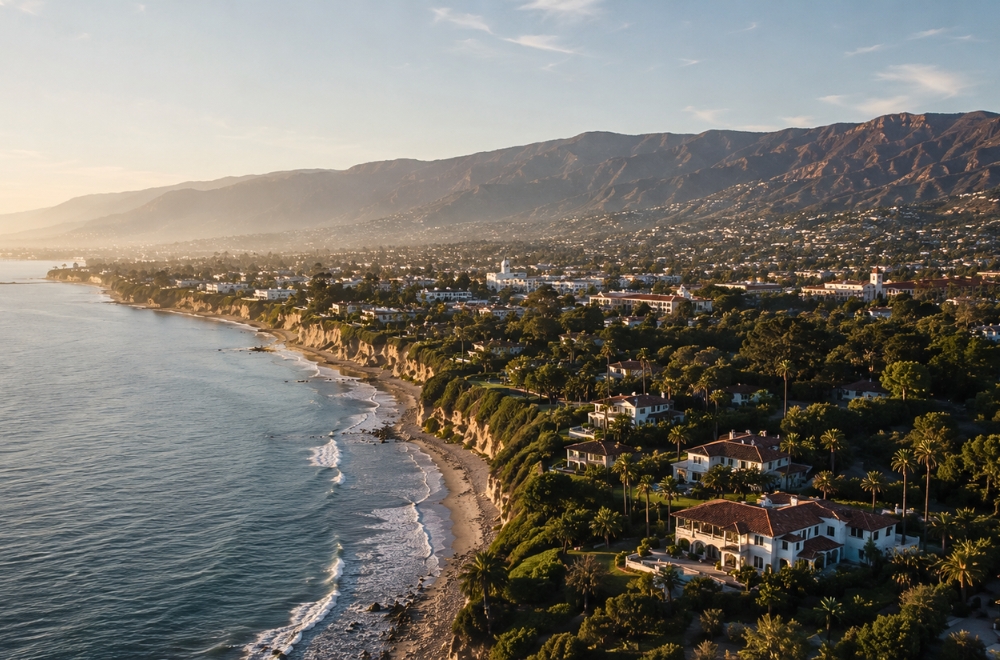
When a debris flow tore through Montecito on January 9, 2018, insurers eventually had to treat much of the damage as fire loss rather than flood loss, since it was the Thomas Fire’s burn scar upstream that caused the hillside to give way, according to California Department of Insurance guidance on the disaster.
That single determination still shapes how homes get insured in this county. Old Harbor Insurance works with Santa Barbara County homeowners to sort through coverage built around coastal, hillside, and high-value risk. A Get a Quote request is a good place to start.
Four separate risks converge on a Santa Barbara County address in a way most California cities never have to sort out at once: a fault line that leveled downtown in 1925, hillside neighborhoods that burned in 2017, a shoreline eroding faster each decade, and Montecito properties valued well above what a standard policy assumes. Sorting out which carrier still writes for which risk takes more than a single quote.
The Debris Flow That Redefined Coverage Here
The Thomas Fire burned through the hills above Montecito in December 2017, and thanks to two decades of fuel-reduction work, only about seven homes in Montecito itself were lost to the fire directly, according to the Santa Barbara County Fire Safe Council’s history of the area.
Six weeks later, an intense storm dropped rain onto the fire’s denuded slopes, triggering a debris flow that killed 23 people and destroyed roughly 100 homes, according to Noozhawk’s year-later retrospective.
That sequence forced an unusual coverage question: flood loss, typically excluded, or fire loss, typically covered? California applies an “efficient proximate cause” rule, and because the wildfire set the disaster in motion, the state directed insurers to treat much of the Montecito damage as fire-caused rather than apply a flood or earth-movement exclusion.
Old Harbor’s claims resource on property coverage covers how a claim moves once the cause of loss itself is in question, the exact dispute many Montecito homeowners faced in 2018.
Wildfire Risk in the Hillside Neighborhoods
Riviera, Mission Canyon, and the northern San Roque foothills all sit in updated Very High or High Fire Hazard Severity Zones under the state’s first area map revision since 2009, according to Santa Barbara Independent coverage of the March 2025 update. The same hillside terrain that makes these neighborhoods desirable also puts them closest to the kind of slope a wind-driven fire needs to spread fast.
The Thomas Fire’s near-miss in Montecito shows mitigation works, but it also shows why underwriters look past a citywide label toward brush proximity, roof material, and defensible space on each parcel. A hillside home two lots from open space rarely gets priced the same as one on a flat interior street.
The 1925 Earthquake’s Lasting Mark on Downtown
A magnitude 6.3 earthquake destroyed or badly damaged 85% of downtown Santa Barbara’s commercial buildings on June 29, 1925, and the failure of the Sheffield Dam released 45 million gallons of water that flooded the lower downtown two feet deep, according to the Santa Barbara Historical Museum. Eleven to thirteen people died, depending on which count is used.
The rebuild that followed banned unreinforced masonry construction and pushed the city toward the unified Spanish Colonial Revival look it’s known for today, a design standard the city still enforces through its historic design review process. Buildings constructed to the older, pre-1925 standard carry different seismic risk than anything built after the code changed.
Coastal Erosion and Sea-Level Rise Along the Shoreline
Santa Barbara is projected to see roughly six and a half feet of sea-level rise by 2100, and even a smaller 2.5-foot rise by 2060 could increase bluff erosion rates by 40%, according to Santa Barbara Independent’s reporting on the region’s coastal outlook. Goleta Beach has already needed emergency rock revetment after repeated storm damage.
None of that shows up on a standard homeowners policy as its own line item, but it does affect how carriers view a coastal-facing property’s long-term insurability, particularly for homes closer to a bluff edge than current setback guidance recommends.
Why Insuring a High-Value Montecito Home Is Different
Chubb covered roughly 60% of the Montecito homeowners market before becoming the area’s primary non-renewer starting in 2022, citing wildfire and debris-flow losses, according to Siteline Santa Barbara’s reporting on the local market. The California FAIR Plan caps residential coverage at $3 million, a limit that hasn’t moved since 2019 even as Montecito’s median home sale price passed $6 million in 2025.
For a home valued well above that cap, a difference-in-conditions policy layered on top of a FAIR Plan or excess policy is often the only way to match a lender’s required coverage amount. Cash buyers have more flexibility than buyers financing a purchase, since a lender requires coverage matched to the loan amount regardless of the FAIR Plan’s ceiling.

How Old Harbor Insurance Helps Santa Barbara Homeowners
Old Harbor’s access to 81 A-rated carriers matters most here, where the dominant local insurer has spent years shrinking its footprint instead of growing it. Chubb’s retreat from Montecito isn’t necessarily every carrier’s retreat, and the only way to tell the difference is by getting more than one quote.
The agency also reviews a property’s specific fire zone, coastal exposure, and construction era before recommending a carrier, and helps put together the layered coverage a high-value Montecito property often needs rather than assuming one policy covers everything.
See What Santa Barbara Coverage Looks Like Today
Insurers write standard policies for an average property, and very little about a Santa Barbara County address is average: a fault line under downtown, a fire-scarred hillside, an eroding coastline, and homes worth more than the state’s insurer of last resort will cover.
Old Harbor reviews Santa Barbara County properties individually, checking fire zone, coastal exposure, and construction era before recommending a carrier. Reach out through Contact Us to go over your property, or start with a Get a Quote request to compare current options.
Frequently Asked Questions
Does a home rebuilt after the Thomas Fire or the Montecito debris flow need special disclosure when getting a new quote?
Usually yes, since insurers ask about prior fire or geologic loss history on a property, even after a full rebuild. Disclosing repair records and permits upfront tends to move underwriting faster than letting a carrier find the history on its own.
Is flood insurance still worth buying in Montecito if debris-flow damage might get covered as a fire loss instead?
It can still be worth it, since the fire-caused coverage determination applies case by case and isn’t guaranteed for every future storm. A standalone flood or debris-flow policy removes the uncertainty of relying on a proximate-cause argument after the next event.
Does living behind a debris basin or catch net lower insurance costs in the Santa Barbara hillside areas?
It can, since documented mitigation infrastructure like a debris basin or catch net is one of the factors carriers weigh when pricing hillside property, similar to defensible space credits for fire risk. Confirming the specific infrastructure protecting a parcel is worth doing before assuming a quote already accounts for it.
Does Santa Barbara’s historic design review process slow down rebuilding after a covered loss downtown?
It can, since a damaged historic building may need to clear additional design review before permits are issued, adding time beyond a typical rebuild schedule. Ordinance and law coverage, which pays the added cost of meeting current code, becomes especially relevant for a historic structure rebuilt under modern seismic requirements.
Does a coastal bluff-top home need a separate erosion endorsement?
Yes, standard homeowners policies generally exclude earth movement and erosion, so a bluff-top property needs a separate conversation about what coverage exists for land loss versus damage to the structure itself. Sudden structural collapse is treated differently than gradual erosion of the land underneath.
Do surplus lines or non-admitted carriers play a role in insuring Montecito’s highest-value homes?
Yes, when standard-market and admitted excess carriers won’t take on a property’s full value or wildfire exposure, a surplus lines carrier not licensed the same way as an admitted insurer sometimes fills that gap. These policies typically cost more and carry different consumer protections than an admitted carrier’s policy, which is worth understanding before choosing one.
Does hosting long-term renters in a Santa Barbara guest house affect a homeowner’s liability coverage?
Yes, regularly renting out a guest house or accessory unit can shift part of a property into business use, which may exceed what a standard homeowners liability limit anticipates. A landlord or rental-specific endorsement is usually needed once renting becomes a regular arrangement rather than an occasional favor.