

When the CZU Lightning Complex Fire tore through the Santa Cruz Mountains in August 2020, nearly 15,000 Santa Cruz County homeowners eventually faced non-renewal notices, and State Farm alone dropped roughly 4,300 policies in the county, according to Lookout Santa Cruz. Old Harbor Insurance works with Santa Cruz County homeowners to find carriers still writing policies here. A Get a Quote request is a good place to start.
This county carries risk most California cities don’t stack in quite the same combination: a fault line whose epicenter sat in the mountains above the city rather than somewhere else, a coastline losing ground to the ocean one storm at a time, and a river that has already rewritten downtown once. Finding the right coverage here means accounting for all three at once instead of treating Santa Cruz like a generic coastal address.
Why Santa Cruz Mountains Insurance Costs Have Spiked
One homeowner whose Boulder Creek-area home was destroyed in the CZU fire saw a rebuild insurance quote rise more than 600%, with a proposed FAIR Plan rate that could push the annual premium past $20,000, according to Lookout Santa Cruz’s reporting. The FAIR Plan itself has proposed increases of up to 50% for homeowners across the county’s fire-prone mountain communities.
Santa Cruz County has since been designated a Fire Risk Reduction Community, a status that opens up wildfire mitigation discounts for homeowners who qualify, according to the same coverage. That designation matters most for homeowners trying to move off the FAIR Plan and back into standard-market coverage.
The CZU Fire and Big Basin’s Destruction
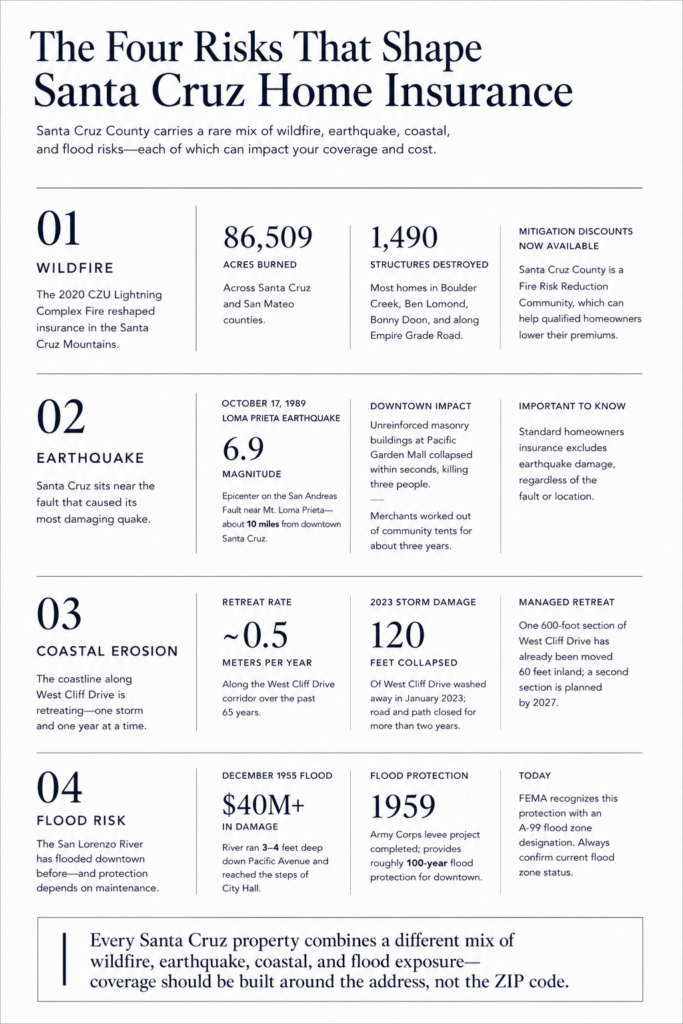
The August 2020 fire burned 86,509 acres across Santa Cruz and San Mateo counties and destroyed 1,490 structures, most of them homes in Boulder Creek, Ben Lomond, Bonny Doon, and along Empire Grade Road, according to Lookout Santa Cruz’s one-year retrospective.
Roughly 97% of Big Basin Redwoods State Park, California’s oldest state park, burned in the same fire, destroying its historic headquarters, lodge, and ranger buildings even though most of the ancient redwoods survived.
The San Lorenzo Valley Water District lost more than half of its assessed water system structures in the fire and is still replacing fire-damaged wooden tanks years later, one measure of how slow mountain infrastructure recovery can be. Old Harbor’s claims resource on property coverage covers how debris removal and code-upgrade costs move through a claim, since the county’s post-fire permitting backlog has pushed some mountain rebuilds well past a policy’s original timeline.
Earthquake Risk From the Fault That Shook Santa Cruz Itself
Most California cities worry about an earthquake centered somewhere else and felt locally. Santa Cruz’s worst one happened in its own backyard. The October 17, 1989 Loma Prieta earthquake, magnitude 6.9, ruptured on the San Andreas Fault near Mt. Loma Prieta, about 10 miles from downtown, according to UC Santa Cruz Library’s oral history archive of the event.
Downtown’s Pacific Garden Mall, built on unconsolidated river sediment, saw its unreinforced masonry buildings collapse within seconds, killing three people in the city’s business district, according to CBS News‘s retrospective on the quake.
Merchants worked out of community tents for roughly three years while downtown was rebuilt, and the disaster accelerated the conversion of the old county jail into what’s now the Santa Cruz Museum of Art & History.
Standard homeowners policies exclude earthquake damage regardless of which fault causes it, and Santa Cruz’s own history is a specific argument for carrying separate coverage rather than treating a quake somewhere else on the San Andreas as the only version worth planning around.
Coastal Erosion Along West Cliff Drive
A January 2023 storm swept away roughly 4,000 tons of boulders and collapsed a 120-foot stretch of West Cliff Drive, closing the road and path for more than two years, according to Lookout Santa Cruz. Retreat along the same stretch has reached half a meter a year over 65 years, according to a Central Coast Wetlands Group study at Moss Landing Marine Labs.
The city has already relocated one 600-foot stretch of West Cliff Drive roughly 60 feet inland and is planning to move a second stretch by 2027, part of a managed retreat strategy the city council has openly debated. None of that shows up as a line item on a standard homeowners policy, but a home sitting close to a bluff edge draws more underwriting scrutiny than one set back from the water.
San Lorenzo River Flood Risk Downtown
The December 1955 flood remains the benchmark event for downtown Santa Cruz: the San Lorenzo River ran three to four feet deep down Pacific Avenue and reached the steps of City Hall, causing more than $40 million in damage, according to the Santa Cruz Public Libraries’ history of the river’s flooding. A 1982 flood came close to repeating it, but levees built after 1955 held.
The U.S. Army Corps of Engineers’ flood control project, completed in 1959, now provides roughly 100-year flood protection for downtown, and FEMA has recognized that protection with an A-99 flood zone designation. That protection depends on ongoing levee maintenance, so a homeowner downtown or along the river corridor should confirm current flood zone status rather than assume 1955-level flooding is permanently off the table.
How Old Harbor Insurance Helps Santa Cruz Homeowners
A Boulder Creek home non-renewed after the CZU fire and a downtown property near the San Lorenzo River are carrying two entirely different risk profiles, even though both sit in the same county. Old Harbor works with 81 A-rated carriers, which means checking more than one company’s appetite before assuming a property is priced out of standard coverage.
The agency also factors in how close a specific address sits to the 1989 rupture, whether it falls inside a mapped fire hazard zone, and how near it is to the river or the bluff edge, since two homes a few blocks apart in this county can carry very different price tags.
See Where Your Santa Cruz Policy Stands Today
A single property here might carry mountain fire history, fault proximity, an eroding bluff nearby, or a spot along the San Lorenzo River, sometimes more than one at once. Old Harbor looks at what’s specific to the address rather than pricing the whole county the same way, then matches it against carriers currently willing to write it. Reach out through Contact Us to go over your property, or start with a Get a Quote request to compare current options.
Frequently Asked Questions
Does a Santa Cruz Mountains home need specific upgrades to qualify for standard wildfire coverage after the CZU fire?
Often yes, since carriers increasingly ask about roof material, ember-resistant vents, and the width of the access road serving a property before writing a policy in a former burn area. A home with a shared, narrow driveway or limited fire truck access can face more restricted options than one with a wider, code-compliant road.
Does living close to the Loma Prieta epicenter cost more to insure for earthquake coverage than a home across the bay?
It can, since some earthquake insurers price a policy partly on proximity to a known fault rupture zone, and the Santa Cruz Mountains sit closer to the 1989 rupture than most Bay Area cities. Getting a specific quote for an address near the epicenter is more reliable than assuming countywide earthquake rates apply evenly.
Does a Westside Santa Cruz home near West Cliff Drive need to disclose erosion risk when it’s sold?
Yes, California’s natural hazard disclosure requirements can extend to known coastal erosion or bluff instability near a property, separate from any insurance requirement. A seller working with an agent familiar with the West Cliff corridor typically has an easier time meeting that disclosure standard accurately.
Does a lender require flood insurance for a home near the San Lorenzo River that sits just outside the highest-risk flood zone?
Not usually, since lenders only mandate flood coverage for properties mapped inside a designated high-risk zone, and the levee project moved much of downtown Santa Cruz out of that category. A homeowner just outside the mandatory zone can still buy a policy voluntarily, often at a lower cost than a required policy inside it.
Does renting out a Santa Cruz Mountains cabin on a short-term rental platform affect wildfire insurance coverage?
Yes, regular short-term rental use typically shifts a property into business use that a standard homeowners policy doesn’t anticipate, which can affect both fire coverage and liability if a guest is on-site during an evacuation. A landlord or short-term-rental-specific endorsement is usually the more reliable option once a cabin is rented out regularly.
Can removing a hazard redwood or fire-damaged tree near a home lower wildfire insurance costs in the Santa Cruz Mountains?
It can, since a dead or fire-weakened tree close to a structure is one of the defensible space factors carriers may flag during underwriting. Some redwoods require local permit approval before removal, so documenting that approval and the completed work helps when showing a carrier the job is done.
Does a non-renewal from a major carrier complicate refinancing a Santa Cruz home?
Yes, lenders require proof of active hazard insurance to complete a refinance, so a non-renewal notice arriving mid-process can delay or stall it if new coverage isn’t lined up quickly. Starting the search for a new carrier as soon as a non-renewal letter arrives gives a refinance more room to close on schedule.