
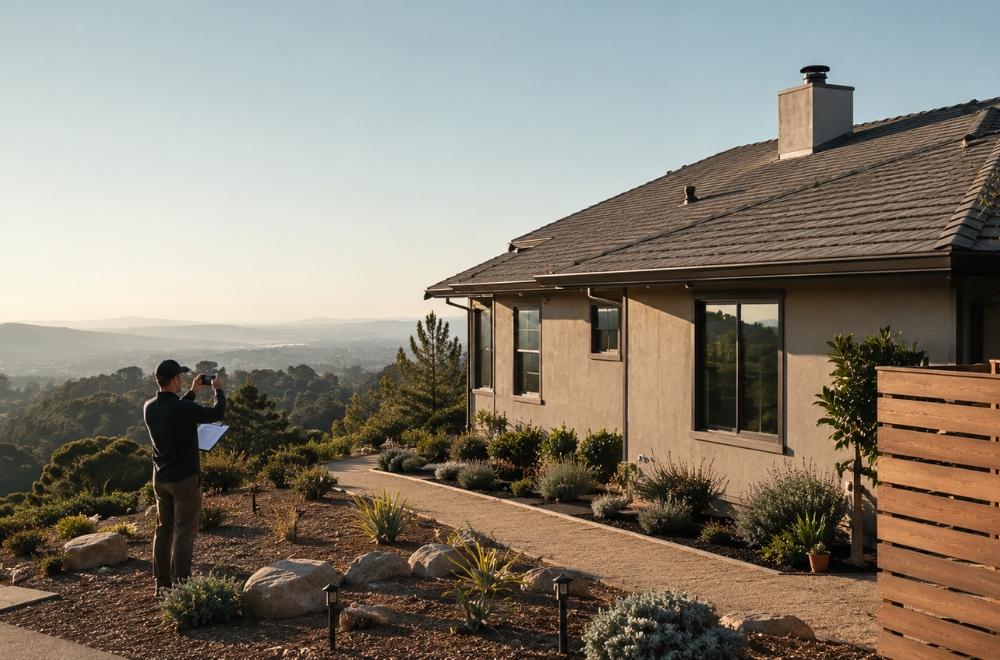
California’s insurers spent three years pulling back from wildfire-exposed neighborhoods. The 2025 Los Angeles fires alone produced an estimated $30 to $35 billion in insured losses.
That trend reversed when the California Department of Insurance tied new wildfire catastrophe models to a home’s compliance with the Safer from Wildfires standard, the checklist that sets a mitigation discount. The department says the shift affects over 1.5 million homeowners in distressed areas and on the FAIR Plan.
Old Harbor Insurance has watched that pairing reopen admitted-market options for homeowners who previously had nowhere to go. For homeowners who already hardened their property, mitigation now counts twice: once for the state discount, and again inside the filings insurers submit to write new policies where they had pulled back.
Knowing both mechanisms helps a homeowner tell whether that spending is being recognized, or simply unclaimed.
What the Safer from Wildfires Standard Requires
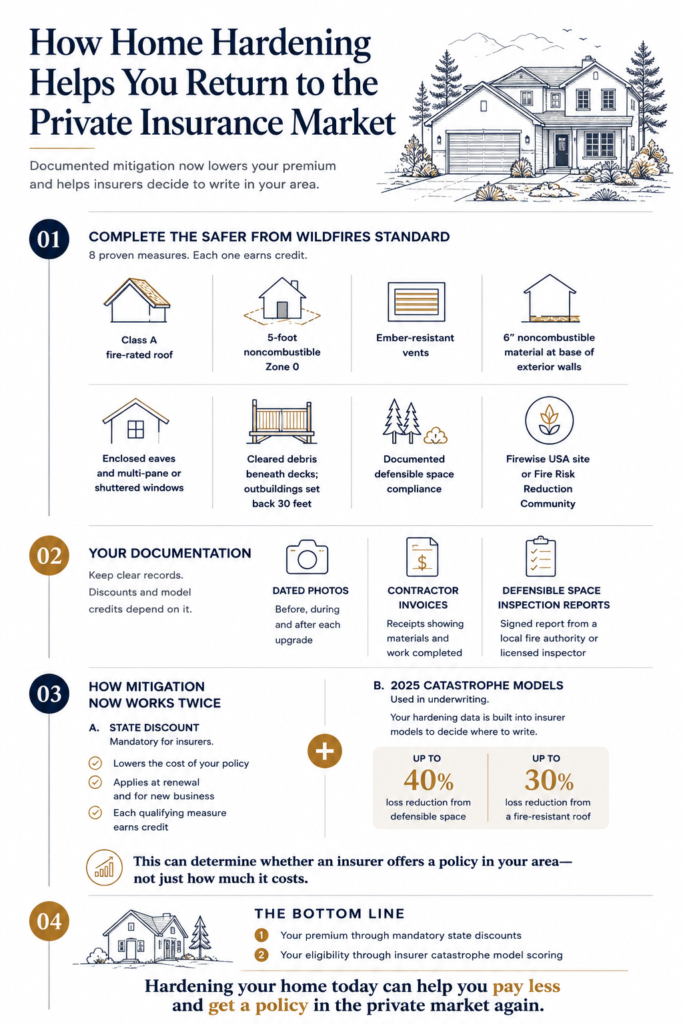
Codified at California Code of Regulations Title 10, Section 2644.9, the standard took effect in October 2022. It requires every admitted insurer that prices by wildfire risk to file a discount for documented mitigation, including:
- A Class A fire-rated roof
- A five-foot noncombustible Zone 0 around the structure
- Ember-resistant vents
- Six inches of noncombustible material at the base of exterior walls
- Enclosed eaves and multi-pane or shuttered windows
- Cleared debris beneath decks and outbuildings set back at least 30 feet
- Documented defensible space compliance
- Participation in a Firewise USA or Fire Risk Reduction Community
Qualifying roofing materials are tracked on the Office of the State Fire Marshal’s approved building materials list, which insurers reference when verifying a claim. Each measure files independently, so a homeowner who completes several steps can stack credits instead of qualifying for one flat discount.
A Standard That Keeps Evolving
State law updated at the start of 2026 directs the department to keep revising this list as fire science and building materials change. The checklist homeowners see today is likely to expand, particularly around ember-resistant fencing and attic ventilation standards still being refined.
That periodic review also means insurers cannot treat the 2022 baseline as permanent. A carrier’s rate filing has to account for whichever version of the standard is current when the filing is submitted, not the version in place when a homeowner first completed the work.
How Hardening Now Feeds the Wildfire Catastrophe Models Insurers Use
The Safer from Wildfires standard used to be the only place mitigation showed up in a rate calculation. That changed in July 2025, when the department finished reviewing the first wildfire catastrophe models built for California ratemaking, developed by Verisk, Karen Clark and Company, and Moody’s. Verisk’s model scores these same attributes, projecting loss reductions of up to 40 percent for defensible space and 30 percent for a fire-resistant roof.
Historical-data pricing, used before the review, could only look backward and had no way to credit a roof replaced last spring. A hardening discount only helps if a carrier will write the policy at all. Once mitigation is built into an insurer’s pricing model, a well-hardened home can change whether it gets a quote in the first place, not just what that quote costs.
Why the State Discount Alone Was Not Enough
A mandatory discount changes what a policy costs, but it never forced an insurer to offer that policy in the first place. Homeowners in the most fire-prone zip codes could complete every item on the checklist and still receive a non-renewal notice, since the discount rule and the decision to write coverage were handled separately.
Tying mitigation credit to the catastrophe models used in rate filings closes that gap. A home’s hardening record now feeds directly into the math an insurer uses to decide whether a neighborhood is worth entering at all.
The Trade Insurers Made to Write in Distressed Areas
Approval to use these models came with a condition. Under Commissioner Ricardo Lara’s Sustainable Insurance Strategy, any insurer using a reviewed model must commit to writing at least 85 percent of its new policies in historically underserved, wildfire-distressed areas, according to United Policyholders, which tracks the requirement across the state’s twelve largest insurers. Mercury, Allstate, and CSAA were the first to notify the department they would file plans under it.
The strategy is meant to move policies out of the FAIR Plan and into the standard market, where pricing is regulated under Proposition 103. The FAIR Plan’s exposure has grown well past what its reserves could absorb after a major event, so every policy that shifts to an admitted carrier eases pressure on a backstop never meant to insure this many homes long-term.
Checking Whether an Address Falls in a Distressed Area
The 85 percent requirement is tied to specific zip codes with a history of coverage non-renewals and heavy FAIR Plan concentration, not to wildfire risk alone. Two homes with similar brush exposure can fall on different sides of that line depending on how many neighbors already lost private coverage.
The department maintains a Home Insurance Finder tool for checking which companies are actively writing in a given area, which is a faster first step than calling carriers one at a time. Old Harbor’s agents cross-reference the same designations when matching a hardened property to a carrier’s current filing.
Turning Mitigation Into a Quote-Ready Property
Discounts and model credits both depend on paperwork, not memory. Dated photos of vent replacements, contractor invoices for roofing work, and a defensible space inspection report give an underwriter something concrete to apply against a discount or a model score.
Homeowners who hardened a property years ago and never filed for the discount are not credited automatically. That paperwork also matters after a loss, since insurers and adjusters reference the same mitigation records when reviewing a property claim.
How Old Harbor Insurance Helps
Old Harbor works with 81 A-rated carriers, several of which are now filing plans to write more policies in wildfire-distressed parts of Southern California under the Sustainable Insurance Strategy. Not every carrier weighs a Class A roof or a completed Zone 0 the same way in its own filing.
Rather than applying to carriers one at a time, Old Harbor’s agents compare how each company’s underwriting treats a specific set of hardening upgrades. For a homeowner still on the FAIR Plan, that comparison also answers whether a carrier’s expansion plans reach their zip code yet, or whether it makes more sense to keep documenting mitigation work and revisit the market in the next filing cycle.
Rooted in Southern California’s Wildfire Risk
Old Harbor is based in Temecula, in the Inland Empire, an area where wildfire exposure shapes coverage decisions for both agents and clients. That local footprint informs how the agency reads a rate filing’s fine print, since regional brush conditions and defensible space enforcement vary even between neighboring cities.
Get Your Hardening Work Recognized
Homeowners who have hardened their property, or are weighing which upgrades to prioritize next, can bring their documentation to Old Harbor and see how it holds up across multiple carriers. That review is especially useful for anyone renewing on the FAIR Plan this year, since the list of admitted carriers accepting new business keeps changing as more file plans under the Sustainable Insurance Strategy.
Contact Old Harbor to review current coverage, or get a quote to see how mitigation work is being priced by insurers actively expanding in California.
Frequently Asked Questions
Does the Safer from Wildfires discount apply to renters or only homeowners?
The regulation is written for property owners with a wildfire-rated policy, so renters insurance is not eligible. A landlord’s hardening work can still lower the cost of the underlying dwelling policy.
Do I need a professional inspection to prove my hardening measures?
Most insurers accept photos and contractor documentation for individual items. Defensible space compliance often requires a signed inspection report from a local fire authority or licensed inspector, and requirements vary by carrier.
Can I keep my FAIR Plan hardening discount if I move to an admitted carrier?
No, discounts do not transfer between policies or carriers. A new insurer recalculates eligibility from scratch, which is why keeping original documentation on hand speeds up the switch.
How long does an approved hardening discount last?
Insurers can require periodic reverification, particularly for defensible space, since vegetation regrows year to year. A discount tied to a permanent feature like a Class A roof typically remains in place as long as the material is unchanged.
Does hardening a home guarantee an admitted carrier will offer a policy?
No, mitigation is one input among several a catastrophe model weighs, alongside location, construction year, and surrounding brush density. Hardening improves a property’s standing but does not override every other factor an insurer considers.
What happens to a hardening discount if the home is sold?
The discount is tied to filed documentation, not the policyholder, so a new owner typically has to resubmit records under their own application. Sellers can speed this along by leaving mitigation paperwork with the disclosure documents.
Are surplus lines carriers required to follow the Safer from Wildfires standard?
No, the standard applies only to admitted insurers regulated under California’s rate approval process. Surplus lines carriers set pricing outside that framework, which is one reason admitted coverage is worth pursuing first when available.