

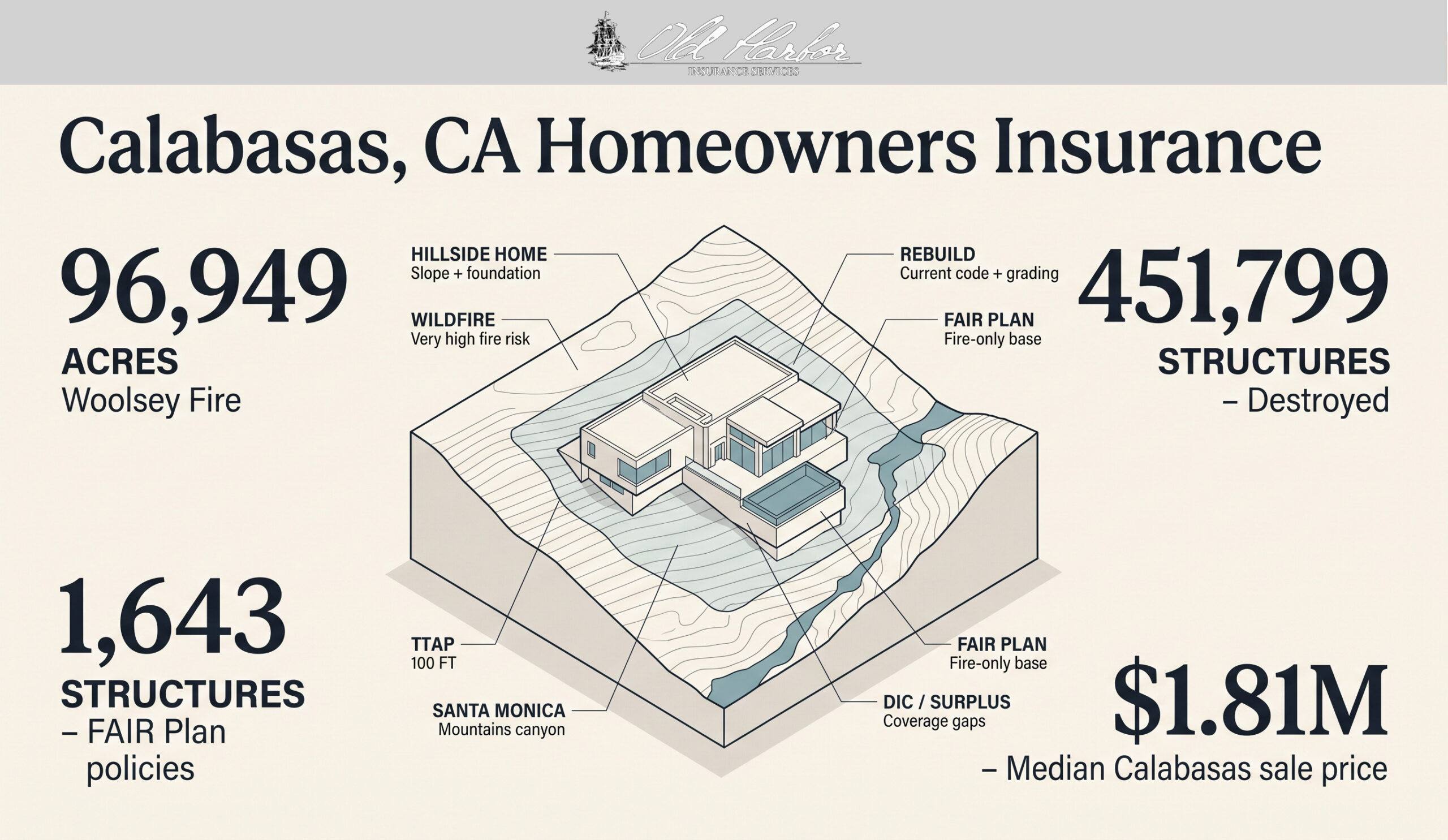
The Woolsey Fire burned 96,949 acres across Los Angeles and Ventura counties in November 2018, destroying 1,643 structures and pushing evacuation orders into Calabasas’s hillside neighborhoods, according to CAL FIRE’s official incident record.
Old Harbor Insurance writes homeowners coverage for a city where canyon lots, gated hillside estates, and narrow private roads all back up against the same Santa Monica Mountains brush that fire has come out of twice in the last eight years.
A policy priced for a flat suburban lot rarely covers what a hillside property here needs: an engineered foundation sized for the slope, retaining walls built to current grading standards, and coverage that holds up if the zone gets reclassified after the next fire season. Better to check that now than find out during a claim.
Understanding Your Calabasas Hillside Coverage: What’s Included?
A Calabasas homeowners policy covers the same five things any California policy does, though hillside terrain changes what each one has to pay for.
Dwelling coverage has to be priced in an engineered foundation, other structures usually means a retaining wall rather than a garden shed, and ordinance or law coverage has to stretch to current hillside grading and fire code requirements, not just a rebuilt roofline.
| Coverage Type | What It Addresses |
| Dwelling / replacement cost | Rebuilding a custom hillside home, including engineered foundations and slope grading |
| Other structures | Retaining walls, guest houses, pool houses, gated entry structures |
| Personal property | Furnishings and belongings, with scheduling available for higher-value items |
| Liability | Injuries to guests, contractors, or neighbors, including slope-related hazards |
| Loss of use | Temporary housing while a covered loss is repaired |
| Ordinance or law | Added cost of meeting current hillside grading and fire code requirements during a rebuild |
Guaranteed Replacement Cost Matters More on a Sloped Lot
Building on a Calabasas hillside costs more per square foot than building on flat ground: an engineered foundation, retaining walls, and equipment that has to reach the site by way of a narrow canyon road all add to the bill.
A guaranteed or extended replacement cost endorsement pays to rebuild at current labor and material costs instead of stopping at a dwelling limit that was set before any of that got priced in.
Defensible Space and Home Hardening Now Factor Into Eligibility
According to the City of Calabasas, CAL FIRE’s March 24, 2025 Fire Hazard Severity Zone map classifies much of the city’s hillside terrain into moderate, high, or very high fire risk zones based on local slope, fuel loading, and fire weather patterns.
Homes in the higher zones fall under California Building Code Chapter 7A construction standards and 100 feet of defensible space clearance, and a growing number of carriers want proof of both before they’ll write or renew a policy.
Why Calabasas Homes Face Wildfire and Hillside Risks
Recent Calabasas Wildfires
The Kenneth Fire ignited on January 9, 2025, burning 1,052 acres across Los Angeles and Ventura counties and triggering evacuation orders in Calabasas before crews achieved full containment three days later, according to the City of Calabasas’s incident report. Occurring just six years after the Woolsey Fire swept through the same hills, it demonstrated how rapidly fires can reach the city under favorable conditions.
Post-Fire Debris Flow Risks on Steep Terrain
Wildfires destroy vegetation and alter soil absorption, making burn areas vulnerable to rapid debris flows during heavy rain. Canyon properties below burn scars in the Santa Monica Mountains remain at high risk for several rainy seasons after a fire.
FAIR Plan & Coverage Options in Calabasas
According to an actuarial analysis from Milliman, statewide FAIR Plan dwelling policies surged 123 percent between September 2020 and September 2024, growing from 202,897 to 451,799 policies, while total insured exposure expanded from $153 billion to $458 billion over the same period.
That growth is concentrated in the same Very High Fire Hazard Severity Zone terrain that runs along Calabasas’s hillsides, which is why a FAIR Plan quote turns up here more often than it does in the flatter parts of the San Fernando Valley just east of the city.
A FAIR Plan policy insures fire damage to the structure but leaves out liability, theft, and water damage, so most Calabasas homeowners who land on it pair it with a Difference in Conditions (DIC) policy to fill those gaps. Surplus lines carriers offer another route for a hillside estate whose dwelling limit or rebuild cost has outgrown what an admitted carrier wants to write.
Calabasas Home Insurance Costs
According to Redfin, Calabasas’s median home sale price reached $1,808,803 as of August 2026, a 20.8 percent increase from the previous year, averaging roughly $669 per square foot.
Sale price isn’t the number a carrier rebuilds to, since a chunk of it is land, but it’s a rough read on how much dwelling and personal property coverage a hillside home here needs, and paired with a Very High Fire Hazard Severity Zone designation, it’s one of the two biggest levers on a Calabasas premium.
A hardened roof, updated vents, and how recently the home was built all shift a quote from there. Two homes of similar size can price differently once one sits behind a manned gate with a wider buffer of cleared brush and the other backs directly onto open hillside.
How Old Harbor Insurance Helps
Old Harbor is an independent agency, not tied to one insurer, and works with more than 80 A-rated carriers across the admitted market, the FAIR Plan, and surplus lines.
For a Calabasas hillside property, that means comparing what several carriers will write for a Very High Fire Hazard Severity Zone address, rather than settling for whatever one company still offers at renewal. It also means a guaranteed replacement cost endorsement, a DIC policy, and umbrella liability can get quoted together as one plan instead of three that don’t line up.
How a claim moves from filing to payout is worth understanding before a policy is needed, not after a fire has already moved through the hills. Which carriers are still writing new business in Calabasas’s higher zones changes throughout the year as capacity shifts.
Protect Your Calabasas Hillside Home
If your Calabasas policy predates the latest Fire Hazard Severity Zone update—or if you’ve added retaining walls, a guest house, or gate upgrades, it’s time to review your coverage. Contact Old Harbor Insurance to review your current policy details, or request a quote to compare rates across standard, FAIR Plan, and surplus-lines options.
Frequently Asked Questions
Does the FAIR Plan cover a retaining wall or hillside landscaping under its other structures coverage?
A FAIR Plan policy’s other structures coverage can extend to a detached retaining wall up to the policy’s sublimit, but ornamental landscaping and slope plantings are typically covered only up to a small combined cap. A homeowner with extensive hillside terracing usually needs that sublimit reviewed against the actual replacement cost.
Can a carrier decline or non-renew a Calabasas policy solely because of its Very High Fire Hazard Severity Zone status?
An admitted carrier can decline or non-renew a policy over its Very High Fire Hazard Severity Zone status, as long as it’s outside a declared-disaster moratorium period. California only limits non-renewals in specific circumstances, like the one-year window after a nearby wildfire, not because of a zone designation by itself.
Does a standard homeowners policy pay for debris flow or mudslide damage after a wildfire burns the hillside above a home?
Standard homeowners insurance excludes earth movement, which includes a landslide or debris flow, even when a recent wildfire is what triggered it. Covering that damage requires a Difference in Conditions policy or a specific earth movement endorsement written separately from the base policy.
Do gated Calabasas communities like The Oaks or Mountain View Estates require homeowners to carry specific liability limits?
Some gated HOA communities in Calabasas set a minimum liability limit in their governing documents, particularly where shared roads, trails, or recreational amenities raise the association’s own exposure. Checking the HOA’s CC&Rs before binding a policy confirms whether a higher limit is required beyond what a standard policy defaults to.
Does completing defensible space brush clearance guarantee a lower premium or a renewed policy?
Defensible space compliance improves a home’s standing with a carrier but doesn’t guarantee a specific premium or automatic renewal on its own. Roof material, construction age, and a carrier’s overall appetite for writing new business in a given zone all factor in alongside brush clearance.
Is earthquake coverage worth adding for a Calabasas home, given the faults that bound the Santa Monica Mountains?
Standard homeowners insurance excludes earthquake damage everywhere in California, regardless of a property’s distance from a mapped fault.
The Santa Monica Mountains bordering Calabasas, home to the National Park Service’s own Santa Monica Mountains National Recreation Area headquarters, are bounded by faults on nearly every side, including the Malibu Coast Fault along the range’s southern edge.
Coverage still requires a separate policy through the California Earthquake Authority or a private carrier, priced on its own and not bundled with whatever wildfire coverage the home already carries.
Does insurance help cover the cost of a geotechnical or soils report required before rebuilding on a Calabasas hillside lot?
A geotechnical or soils report required by the city before rebuilding on a slope is a permitting cost, not repair of physical damage, so a standard dwelling limit doesn’t automatically include it. Ordinance or law coverage sometimes reaches that expense depending on the policy’s terms, which is worth confirming with an agent before a contractor prices the rebuild.