
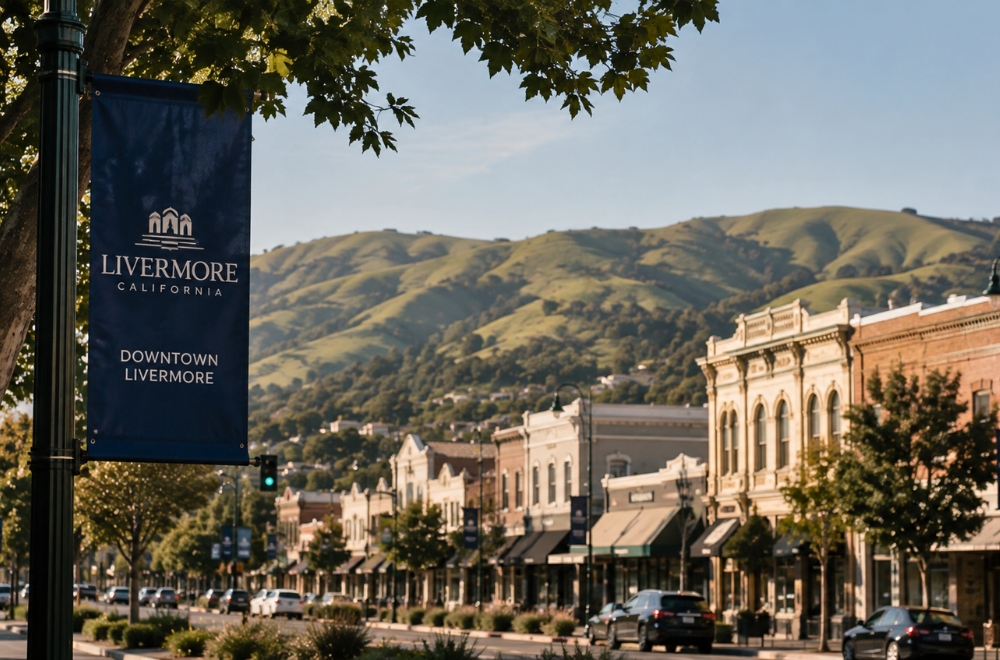
The Greenville Fault runs beneath parts of Livermore. Its last major rupture, in January 1980, produced a 5.8-magnitude earthquake followed by a 5.3 aftershock two days later. Livermore home insurance has to account for that fault line, along with the wildfire risk building up in the hills around town. Old Harbor Insurance writes coverage for homeowners across Livermore, Pleasanton, and Dublin.
Standard policies exclude earthquake damage no matter which fault caused it, a detail many homeowners only discover in the exclusions page. Wildfire pricing varies almost as much: a home near the hillsides and one a mile away on flatter ground can land in different hazard zones. Knowing both, for a specific address, matters more than assuming last year’s policy still applies.
Why Livermore Homeowners Face Two Distinct Risks
The Greenville Fault and Livermore’s Seismic History
The Greenville Fault ruptured along roughly four to six kilometers of its length during the January 1980 sequence, according to USGS’s survey of the surface faulting, with a smaller companion rupture along the nearby Las Positas Fault. The mainshock and aftershock caused about $11.5 million in damage, much of it at Lawrence Livermore National Laboratory, and damaged roughly fifty homes as far away as Tassajara. The fault remains active, and USGS considers it capable of another surface-rupturing earthquake.
Wildfire Risk in the Livermore Hills
Cal Fire’s statewide map update, released in February 2025, reclassified fire hazard zones across Livermore into Moderate, High, and Very High categories, according to the city’s own wildfire preparedness page. The Livermore-Pleasanton Fire Department maintains an address-level lookup tool, so a specific parcel can be checked rather than guessed at by neighborhood. Homes near the hillsides on the valley’s edges are the ones most likely to see a change in how a carrier prices wildfire risk.
What Standard Home Insurance Covers in Livermore
A standard homeowners policy in Livermore typically bundles coverage for the dwelling, other structures such as a detached garage or shed, personal property, and liability for injuries on the property. Loss of use coverage pays for temporary housing if a covered loss makes the home unlivable while it’s rebuilt and any claim moves through the process. Ordinance or law coverage, which pays the added cost of rebuilding to code, is worth checking given how many Tri-Valley homes predate current standards.
None of this includes earthquake or flood damage, both of which require separate policies regardless of how far a property sits from the Greenville Fault or a nearby arroyo. An agent can identify which of those gaps apply to a specific address, rather than leaving a homeowner to guess based on a neighbor’s policy.
Earthquake Coverage for Livermore Homeowners
Standard homeowners insurance in California excludes earthquake damage, so coverage has to be added through the California Earthquake Authority or a private carrier. CEA policies are purchased through a participating home insurer rather than directly, not as a standalone product. Given the Greenville and Calaveras faults nearby, it’s a coverage question worth raising even for homes that have never had a claim, since seismic risk doesn’t show up on a claims history.
How Much Does Livermore Home Insurance Cost?
Premiums vary by which fire hazard zone a property sits in, the home’s age and construction, and how much dwelling coverage a full rebuild would require at current construction costs. A newer home in a flatter part of town, away from the hillside Very High zones, typically prices lower than an older property closer to open space. Roof material and recent electrical or plumbing updates factor in too, since both affect how a carrier views the home’s overall risk.
Adding a separate earthquake policy through the California Earthquake Authority increases the total cost of coverage, and the amount depends on the home’s age, foundation type, and distance from the Greenville and Calaveras faults. Comparing a standard-only quote against one that includes earthquake coverage gives a clearer picture of what full protection costs for a specific Tri-Valley address, rather than guessing at the difference.
How Old Harbor Insurance Helps
Old Harbor Insurance is an independent agency working with more than 80 A-rated carriers, so a Tri-Valley property gets shopped across insurers that price earthquake and wildfire risk differently rather than accepting whatever a single company quotes first. That range matters in Livermore, where two homes a few streets apart can sit in different fire hazard zones and end up with noticeably different quotes for the same square footage.
Agents walk through whether a separate earthquake policy makes sense for a specific address, rather than defaulting to a blanket recommendation for every Tri-Valley homeowner. The agency also tracks which carriers are actively writing new policies in Livermore’s higher hazard zones, since a carrier that declined a property last year may already be back in the market this year.
Get Tri-Valley Coverage Built Around Your Address
A policy that made sense for a Livermore home a few years ago may not reflect the current fire hazard zone or account for the earthquake coverage question at all. Contact Old Harbor Insurance to review what a specific Tri-Valley address currently qualifies for, or request a quote to compare standard coverage against an added earthquake policy, especially if the home hasn’t been reviewed since the 2025 zone update.
Frequently Asked Questions
Do Livermore homeowners near Arroyo Mocho or Arroyo Las Positas need separate flood insurance?
Standard homeowners insurance and the California Earthquake Authority both exclude flood damage, so a property near Arroyo Mocho, Arroyo Las Positas, or another Tri-Valley waterway needs a separate flood policy to be covered at all. Flood insurance is typically purchased through the National Flood Insurance Program or a private flood carrier, not added as an endorsement to a standard policy. A property’s flood zone status can be checked through FEMA’s map service before assuming coverage already exists.
Does a home’s distance from a fire station or hydrant affect insurance rates in Livermore?
Insurers do factor in a property’s distance from a fire station and hydrant when rating a policy, a factor the Alameda County Fire Department also references in its zone guidance for unincorporated parts of the Tri-Valley. Homes on the edges of Livermore closer to open hillside can see a different rating than one a few blocks from a fire station downtown. This is separate from the fire hazard severity zone a property sits in, and carriers weigh both.
Does the region’s clay soil affect coverage for foundation cracking?
Standard homeowners policies generally exclude gradual earth movement, including the foundation cracking that clay soil common in the Tri-Valley can cause as it expands and contracts with moisture. This exclusion applies whether the movement is tied to soil conditions or a fault rupture, since both fall under the same earth movement category. A foundation issue caused by a sudden, specific event, like a burst pipe undermining the slab, is typically handled differently than gradual settling.
Can a retrofit, like foundation bolting or cripple wall bracing, lower the cost of earthquake coverage?
Retrofitting an older home with foundation bolts or cripple wall bracing can qualify a homeowner for a premium discount on a California Earthquake Authority policy, since the state’s rates factor in a home’s structural resilience. Homes built before the mid-1990s are the ones most likely to lack this bracing and see the biggest discount potential. A retrofit inspection is usually required before a carrier applies the discount, and the inspection itself can also flag other structural issues worth addressing.
Are Livermore’s older homes near downtown underwritten differently than newer Tri-Valley developments?
Older homes near downtown Livermore often carry outdated electrical, plumbing, or roofing systems that some carriers underwrite more cautiously than a newer Tri-Valley subdivision built to current code. That doesn’t mean an older home can’t get standard coverage, but an inspection or specific updates may be requested before a policy is issued. Newer construction can sometimes qualify for construction-related discounts an older home won’t see, though a well-maintained older home isn’t automatically penalized for its age alone.
Does living near Lawrence Livermore National Laboratory affect personal homeowners insurance rates?
Proximity to Lawrence Livermore National Laboratory does not typically factor into a standard homeowners insurance rate the way a fire hazard zone or fault line does. Rating models are built around fire, earthquake, crime, and construction data rather than proximity to a specific facility. Homeowners with questions about a particular address can ask an agent to walk through what is driving their quote, rather than assuming the laboratory itself plays a role.
Does homeowners insurance in Livermore cover a home wine cellar or wine collection?
A home wine collection is typically covered as personal property under a standard homeowners policy, though most policies cap coverage for the collection well below its replacement value unless a specific endorsement is added. Given how many Livermore Valley households keep a personal cellar, that sublimit is worth checking against an actual collection’s value. A scheduled personal property endorsement can raise or remove that cap for an itemized, appraised collection.