

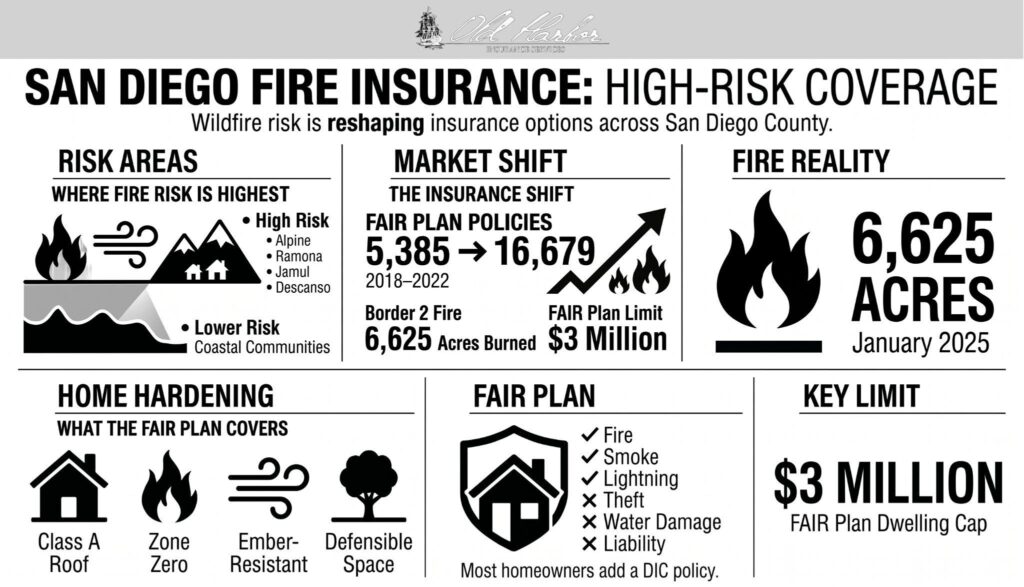
San Diego County FAIR Plan policies more than tripled between 2018 and 2022, climbing from 5,385 to 16,679 as carriers pulled back across the region, according to California Department of Insurance data reported by KPBS. That surge is concentrated in the county’s eastern backcountry, where chaparral, steep terrain, and Santa Ana winds combine to push standard carriers out. Old Harbor Insurance works with homeowners across these inland communities to assemble coverage when the admitted market says no.
A home in Alpine and a home in Encinitas are not the same insurance problem, even though both sit in San Diego County. Knowing where a specific address falls on the risk map determines whether a standard carrier will service it, and that is worth checking before anyone assumes the FAIR Plan is the only option left.
Why San Diego County sits in the high-risk tier
San Diego’s fire exposure is not evenly distributed. The county’s western coastal cities carry lower wildfire scores, while East County and the rural backcountry rank among the most hazardous landscapes in Southern California. This split is why two homeowners ten miles apart can receive wildly different quotes, or no quote at all.
The January 2025 Border 2 Fire illustrated the threat. It burned 6,625 acres in the Otay Mountain Wilderness near the U.S.-Mexico line and forced evacuation orders across eastern Chula Vista and Otay-area neighborhoods, per CAL FIRE incident records. No structures were lost, but the burn footprint sat directly against suburban edges that carriers once treated as safe.
| Metric | Figure |
| County FAIR Plan policies, 2018–2022 | 5,385 → 16,679 |
| Border 2 Fire footprint, Jan 2025 | 6,625 acres |
| FAIR Plan dwelling cap | $3 million |
The FAIR Plan covers fire, not everything else
When private carriers decline a San Diego home, the California FAIR Plan becomes the fallback. Its dwelling policy is a named-perils contract covering loss from fire, lightning, internal explosion, and smoke, as stated on the FAIR Plan’s official policy page. It does not include liability, theft, or water damage.
A standalone FAIR Plan policy leaves real gaps. Most San Diego homeowners pair it with a Difference in Conditions (DIC) policy that wraps around the fire coverage to restore liability, theft, and water protection, bringing coverage closer to that of a standard homeowners policy.
Two recent regulatory shifts matter for claims. In June 2024, the FAIR Plan removed its disputed “sight and smell” smoke-damage standard. As of July 2025, it must publish its financial statements and board records in accordance with transparency rules issued by the Insurance Commissioner. Both changes affect how San Diego claims for smoke and partial losses are evaluated.
How mitigation changes what you can buy
San Diego carriers increasingly price defensible space and home-hardening directly into eligibility. Documented mitigation can move a property from FAIR-Plan-only into the admitted or surplus market, which usually means broader coverage at a lower combined premium.
| Mitigation step | Why carriers weigh it |
| Zone Zero clearance (0–5 ft) | Removes ember-catching fuel directly against the structure |
| Class A roof | The single most-cited underwriting factor in brush ZIPs |
| Ember-resistant vents | Closes the most common ignition path during Santa Ana events |
| 100-ft defensible space | Required documentation for many East County placements |
How Old Harbor Insurance helps
Old Harbor represents 81 A-rated carriers, so a San Diego home gets checked against the admitted market, surplus lines, and the FAIR Plan in one pass. In East County especially, the first “no” is rarely the last word, and a property a State Farm or Allstate underwriter declines often still has a home in surplus lines.
The team also handles the FAIR Plan and DIC as a single package rather than two separate policies, which matters when a lender or escrow desk wants to see how everything fits together before filing a claim after a covered loss.
Get a clear picture of your coverage options
If a carrier already turned you down, that is the moment to check your property against the full market rather than settling for fire-only coverage. The surplus market sometimes writes what the admitted market won’t, and the only way to know is to run the address.
Get a quote or contact us to start.
Frequently asked questions
Is fire insurance required for a home in San Diego County?
The state does not legally mandate fire coverage, but mortgage lenders require it as a condition of the loan. Homes in high-hazard East County ZIPs almost always need it bound before escrow can close.
Which San Diego areas are hardest to insure?
The eastern and backcountry communities carry the steepest wildfire scores, including Alpine, Jamul, Ramona, Descanso, and Potrero. Carriers in these zones often require documented defensible space before they will quote.
Does a FAIR Plan policy cover wind or theft in San Diego?
No, the FAIR Plan dwelling policy only responds to fire, lightning, internal explosion, and smoke. Wind, theft, liability, and water damage require a separate Difference in Conditions policy layered on top.
Can a coastal San Diego home still be denied fire coverage?
Yes, proximity to the coast does not guarantee acceptance. Wind-driven embers and adjacent canyon brush mean carriers evaluate the specific parcel, not just the city.
How much can a San Diego FAIR Plan plus DIC policy cost?
A FAIR Plan policy paired with DIC averaged about $3,200 a year statewide in 2022, compared with roughly $1,480 for a standard California homeowners policy. In San Diego’s heavy-brush ZIPs, the gap is wider, which is the main reason it pays to confirm the admitted market is truly closed first.
What is the maximum the FAIR Plan will insure a dwelling for?
The current residential dwelling limit is $3 million, raised from $1.5 million in 2020. Higher-value San Diego homes may need supplemental coverage beyond that ceiling.
Will home hardening actually lower my San Diego premium?
Documented mitigation can move a property out of FAIR-Plan-only status and into the admitted or surplus market, which typically lowers the combined premium. Keep records of roof class, vent upgrades, and clearance work to present to underwriters.